



North Beach, Miami — A Cheat Sheet for Buyers, Visitors, & the Curious

Amit Bhuta
I use non-traditional marketing to inspire the most motivated buyers to pay the max for Miami luxury homes...
I use non-traditional marketing to inspire the most motivated buyers to pay the max for Miami luxury homes...
North Beach isn’t the Miami Beach you’re used to — and lately, more people are realizing that’s not a bad thing.
Offering a different vibe from the moment you arrive, North Beach sits in the northern section of Miami Beach, defined more by direct beach access, walkability, local businesses, historic pockets, and a residential atmosphere that draws both long-term locals and people priced out of more expensive parts of the island than by nonstop tourism.
Add that to an extensive selection of affordable Miami Beach real estate, and it’s no surprise that more people are searching North Beach, asking questions about boundaries, direct beach access, crowd levels, walkability, rentals, schools, parking, parks, subareas like Altos del Mar, and how North Beach compares with South Beach and Mid-Beach.
This guide has the answers you need.
Here's what you need to know about living in, visiting, and understanding North Beach.
-topaz-upscale-2.1x.jpeg?w=1140)
LIVING IN NORTH BEACH
Where exactly is North Beach in Miami Beach?
North Beach is the northern section of Miami Beach, generally understood as running from about 63rd Street or 65th Street up to 87th Terrace, just below Surfside.
It is part of the City of Miami Beach rather than a separate municipality.
In practical terms, that means North Beach sits above Mid-Beach and below Surfside, with the Atlantic Ocean on the east side and inland residential sections extending west toward the bay side of northern Miami Beach.
The exact block matters here because living east of Collins, near Harding Avenue, close to the Bandshell, or beside the park corridor can produce very different day-to-day experiences even within the same broader district.
What streets define North Beach?
For broad neighborhood use, North Beach is commonly framed as the part of Miami Beach north of 63rd Street and south of 87th Terrace.
A tighter planning-style definition often uses 65th Street as the southern edge, 87th Terrace as the northern edge, the Atlantic Ocean as the eastern edge, and the western side of the neighborhood grid near Rue Notre Dame as the inland edge.
Within that larger geography, local identity gets more specific.
Sections around Collins Avenue, Harding Avenue, 71st Street, the North Shore Historic District, Altos del Mar, and the oceanfront park corridor all shape how residents and visitors think about North Beach on the ground.
What is Altos del Mar, and is it part of North Beach?
Yes. Altos del Mar is part of North Beach and refers to a historic residential section in the upper part of the neighborhood near the ocean.
It is known for a quieter, more tucked-away feel than some of the denser apartment and condo stretches elsewhere in North Beach.
That matters because someone searching North Beach broadly may be looking at mixed-use streets and multifamily corridors, while someone searching Altos del Mar is often looking for a more distinctly residential environment close to the sand.
Is North Beach part of Miami or Miami Beach?
North Beach is part of Miami Beach.
It is not part of the City of Miami, and it is not a separate city with its own government.
That distinction affects branding, public services, zoning context, school planning, park access, and how people compare the area with South Beach, Mid-Beach, Surfside, or mainland neighborhoods west of Biscayne Bay.
Does North Beach have direct beach access?
Yes. Direct Atlantic beach access is one of North Beach’s biggest defining advantages.
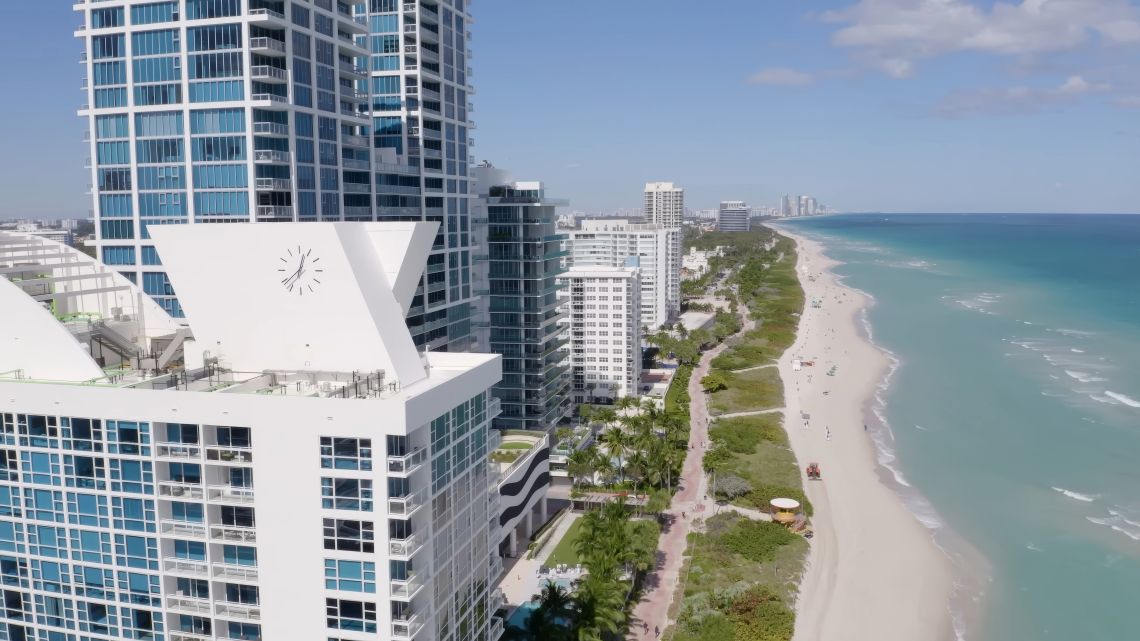
Residents and visitors can reach the sand through multiple public access points, and the experience is reinforced by the Beachwalk, the park corridor, and the long oceanfront stretch that runs through North Beach Oceanside Park.
This is one of the main reasons North Beach should never be framed like a bayfront area such as North Bay Village.
Is North Beach oceanfront or bayfront?
North Beach is fundamentally an oceanfront district.
Its identity is tied to the Atlantic shoreline, beachfront parks, dunes, direct sand access, and the Beachwalk rather than to marinas, bay views, or causeway living.
That difference shapes everything from lifestyle expectations to pricing psychology.
People searching North Beach are usually looking for actual beach proximity and a quieter Miami Beach experience, not a waterfront view across the bay.
What is the beach like in North Beach?
North Beach’s beach experience is usually quieter, less crowded, and more local-feeling than South Beach.
The shoreline feels broader and more relaxed, and the surrounding district is more residential and less built around nonstop visitor traffic.
That does not mean it is empty.
On weekends and good-weather beach days, it still draws residents and visitors, but the overall atmosphere is calmer, less performative, and less dominated by party-driven tourism than the city’s southern sections.
Are North Beach beaches less crowded than South Beach?
In general, yes.
North Beach is widely treated as one of the quieter alternatives within Miami Beach because the surrounding district is more residential and less concentrated with major nightlife and hotel activity.
That lower-intensity setting is one of the area’s strongest draws for both residents and visitors.
It gives North Beach a more relaxed beach-day feel without giving up the Miami Beach shoreline itself.
How big is North Beach Oceanside Park, and where is it located?
North Beach Oceanside Park spans nearly 28 acres along Collins Avenue between 79th and 87th Streets.
That size makes it one of the most important physical anchors in the neighborhood and one of the reasons North Beach feels more open than many tighter parts of Miami Beach.
Because the park runs beside the ocean and the Beachwalk, it shapes both resident life and visitor experience.
It is not a small decorative green strip.
It is a major part of why North Beach feels breathable, outdoorsy, and more park-linked than people expect.
What types of properties are in North Beach?
North Beach is primarily a condo, apartment, and multifamily market.
The housing stock includes older walk-up buildings, mid-rise and high-rise condos, rental buildings, smaller multifamily properties, and a thinner layer of detached houses in select residential pockets.
Size ranges vary widely by building age and product type.
Many older studios are roughly 400 to 550 square feet.
Many one-bedroom units range from 550 to 850 square feet.
Many standard two-bedroom units fall around 900 to 1,300 square feet.
Larger premium units can exceed 1,400 to 1,800 square feet when they sit in better-positioned or more upscale buildings.
Are there condos or houses in North Beach?
There are both, but condos and apartments define the market much more than detached houses do.
Most people searching North Beach are comparing buildings, floor plans, parking setups, and proximity to the beach rather than sifting through large inventories of single-family homes.
Houses do exist in certain pockets, especially in quieter residential sections closer to Altos del Mar and the broader northern Miami Beach fabric.
Still, North Beach is first and foremost a walkable beachside multifamily district.
For more information, check out Condominium Living in North Beach.
How much do condos cost in North Beach, Miami Beach?
Older studios and smaller dated one-bedrooms often begin in roughly the low-to-mid $200,000s, especially when the interiors need updating, the building is older, or the unit sits a few blocks from the sand rather than directly adjacent to it.
Entry-level one-bedrooms commonly move through the mid-$200,000s into the low $400,000s, depending on renovation level, parking, and building condition.
A large share of standard one-bedroom and two-bedroom resale condos sits around the $400,000s to $700,000s.
Renovated two-bedrooms with better layouts, outdoor space, or stronger ocean proximity can push higher.
Larger premium units in better-positioned buildings can move into the upper hundreds of thousands or above $1 million.
Meanwhile, the price per square foot can vary widely depending on proximity to the beach and building condition
In North Beach, pricing is driven by a mix of beach access, walkability, building condition, age of the structure, parking, and how quiet or active the immediate block feels.
What are HOA fees like in North Beach condos?
HOA fees in North Beach vary significantly depending on building age, amenities, and level of service.
In older walk-up or basic buildings, monthly fees can range from roughly $300 to $700.
In mid-range buildings with pools, elevators, and secured entry, fees often fall between $700 and $1,200 per month.
In larger or more amenity-driven buildings, especially those closer to the ocean or recently upgraded, fees can exceed $1,200 to $1,800 per month.
The more important issue is not just the monthly fee, but what it includes, whether reserves are properly funded, and whether the building is exposed to potential special assessments.
How much does it cost to rent in North Beach?
Older walk-up studios and more basic one-bedroom rentals can start around the high $1,000s to low $2,000s, especially when the unit is compact, the finishes are simple, or the building offers limited amenities.
Many standard one-bedroom and two-bedroom rentals range from the low-to-mid $2,000s into the $3,000s.
Price jumps usually track size, condition, parking, balcony access, in-unit laundry, and closeness to the beach.
Updated two-bedrooms, larger units, and better-positioned beach-adjacent rentals often rise into the mid-$3,000s and $4,000-plus range.
Premium rentals can go above that when they combine stronger square footage, newer interiors, secured parking, and a more upscale building profile.
For renters, North Beach is usually a lifestyle-access market rather than a bargain market.
Is North Beach good for long-term renters?
Yes. North Beach is one of the more practical sections of Miami Beach for long-term renters because it combines direct beach access with a stronger year-round residential rhythm than many visitor-heavy districts.
It has enough apartment and condo inventory, enough daily-life infrastructure, and enough neighborhood texture that it works as a real home base rather than as a short-stay zone pretending to be one.
That does not make it inexpensive.
It does make it more realistic for renters who want to stay in Miami Beach full-time.
Can you do Airbnb or short-term rentals in North Beach?
Short-term rental rules in North Beach are heavily regulated and vary by zoning and building.
In most residential buildings, especially standard condo associations, rentals under six months or one year are often restricted or prohibited.
Certain hotel zones and designated areas along Collins Avenue may allow short-term rentals, but these are exceptions rather than the norm.
In practice, buyers and investors should verify both city regulations and individual building rules before assuming short-term rental income is allowed.
Is North Beach cheaper than South Beach or Mid-Beach?
Generally, yes.
North Beach tends to offer a lower entry point than many parts of South Beach and Mid-Beach because it has more older housing stock, less luxury-hotel concentration, and a more local residential identity.
That relative affordability is one of the main reasons North Beach attracts both buyers and renters who want Miami Beach access without immediately paying for the highest-profile addresses on the island.
Cheaper in North Beach usually means comparatively more attainable, not low-cost.
Why is North Beach more affordable than other parts of Miami Beach?
North Beach is helped by a bigger share of older buildings, fewer ultra-luxury clusters than Mid-Beach, and a less tourism-saturated image than South Beach.
It still has beach access and Miami Beach branding, but it does not carry the same premium attached to the island’s most iconic hotel corridors and nightlife-centered districts.
That mix attracts people who care more about function, livability, and beach access than about headline addresses.
It also explains why the area often appeals to long-term residents, quieter visitors, and value-conscious Miami Beach shoppers at the same time.
Is North Beach walkable?
Yes. By Miami-area standards, North Beach is one of the more genuinely walkable beach neighborhoods.
Residents in the right parts of the district can often walk to the ocean, restaurants, coffee shops, local services, parks, and portions of the Beachwalk.
Walkability is strongest near Collins Avenue, Harding Avenue, 71st Street, and the Bandshell and park corridor.
It is not perfect car-free urbanism in the Northeast-city sense, but it is meaningfully better than car-dependent bayfront enclaves or suburban neighborhoods farther inland.
Can you live in North Beach without a car?
Yes, more realistically than in many other Miami-area neighborhoods.
Someone who lives near the beach, daily services, and neighborhood commercial streets can manage without a car far more easily here than in places built around causeway commuting or isolated residential islands.
Still, going fully car-free depends on work location, school routines, medical needs, and how often someone leaves Miami Beach.
North Beach makes car-light living possible for many people, but not automatic for every household.
What is daily life like in North Beach?
Daily life in North Beach feels more neighborhood-oriented than many outsiders expect from Miami Beach.
The area blends regular routines like school drop-offs, dog walks, coffee stops, and beach access with apartment living, older condos, parks, and local-serving businesses.
That mix is one of the area’s biggest strengths.
People can reach the sand quickly without feeling like they live inside a nonstop tourist set.
North Beach often feels like ordinary life with the Atlantic attached to it.
Is North Beach more residential or touristy?
North Beach is more residential than South Beach and much of Mid-Beach.
Visitors are present, especially near the beachfront and hotels, but the area’s identity is supported by schools, apartments, condos, parks, and neighborhood-serving streets that give it a stronger year-round local base.
That balance is one of the neighborhood’s biggest advantages.
It lets North Beach feel Miami Beach recognizably without relying on constant tourism intensity to define itself.
Are there grocery stores, restaurants, and shops in North Beach?
Yes. North Beach functions better as an everyday neighborhood than a one-purpose beach strip, so residents have access to restaurants, small retail, local services, and routine errands within the district or very close by.
The mix is not as broad as a major mainland retail corridor, but it is strong enough that many residents choose North Beach precisely because they can handle much of daily life without treating every errand like a cross-bay trip.
That everyday functionality is one of the clearest differences between North Beach and more purely visitor-driven parts of Miami Beach.
For shopping around North Beach, visit the Top 5 Shopping Spots in North Beach.
Are there good schools in North Beach, Miami Beach?
Yes. Two of the clearest elementary anchors associated with the broader North Beach area are Biscayne Beach Elementary at 800 77th Street and North Beach Elementary at 4100 Prairie Avenue.
For later grades, families commonly evaluate Nautilus Middle School at 4301 North Michigan Avenue and Miami Beach Senior High School at 2231 Prairie Avenue.
That school network is one of the reasons North Beach reads as a true residential district rather than just a beach backdrop.
Families researching the area are not only asking about sand and pricing.
They are also looking at practical year-round living patterns.
Best Schools in North Beach names some of the top schools in the area.
Is North Beach a good place to live for families?
It can be. North Beach offers a more family-plausible version of Miami Beach than many people assume, thanks to beach access, park access, public-school options, and a less nightlife-driven atmosphere than South Beach.
It is still more vertical and condo-oriented than a classic suburban neighborhood, so it will not suit every family.
But for households comfortable with apartment or condo living, the area can provide a compelling mix of parks, schools, walkability, and coastal setting.
Are there older buildings in North Beach that buyers should evaluate carefully?
Yes. A meaningful share of North Beach housing comes from older construction eras, especially in the condo and apartment stock.
Buyers should look carefully at reserves, maintenance history, insurance posture, concrete work, roof condition, parking configuration, and overall building management rather than focusing only on the unit interior.
This matters in North Beach because two units can look similar in price, square footage, or distance from the beach while offering very different ownership risk once the building itself is examined.
In an older beachside market, the building is often as important as the floor plan.
Does North Beach flood or experience storm surge risk?
North Beach, like all barrier island communities in Miami Beach, sits at a low elevation and is exposed to flooding risk from heavy rain, king tides, and storm surge.
Certain streets and older infrastructure zones may experience temporary flooding during high-water events, especially closer to lower elevations and older drainage systems.
Newer improvements and citywide resilience projects have reduced some of this impact, but conditions can still vary by block and building elevation.
For buyers, the key factor is not just neighborhood-wide risk, but how a specific building is positioned, elevated, and engineered.
Is property insurance expensive in North Beach?
Insurance costs in North Beach can be higher than in inland areas due to coastal exposure, building age, and hurricane risk.
Older buildings, especially those without updated systems or strong reserves, may face higher premiums or stricter underwriting requirements.
Condo owners typically pay insurance through HOA fees, while single-family homeowners carry separate policies that can vary widely depending on elevation, construction, and coverage.
Insurance is one of the most important hidden costs to evaluate when buying in North Beach.
Is North Beach, Miami Beach, safe?
North Beach is generally perceived as calmer and more residential than South Beach, which shapes how safe it feels day to day.
But as with most urban beach neighborhoods, the real experience depends heavily on the exact block, lighting, building access control, parking setup, and whether someone is near a quieter residential stretch or a busier commercial corridor.
For many residents, the practical question is not simply whether North Beach is safe in the abstract.
It is whether a specific address feels comfortable at night, how well the building is managed, and how active or quiet that exact stretch of street becomes after dark.
Is parking difficult in North Beach?
It can be. Parking pressure is one of the most common quality-of-life frictions in North Beach, especially in denser residential sections, older buildings with limited spaces, and beach-adjacent blocks where visitor demand competes with resident needs.
For buyers and renters, parking policy deserves more scrutiny than people often give it at first glance.
Guest parking, second-car parking, and street availability can materially affect how easy a place is to live in.
Do residents need parking permits in North Beach?
Yes. Many areas of North Beach use residential parking permit systems to manage street parking demand.
Residents can apply for permits through the City of Miami Beach, which allows access to designated zones at reduced rates compared to visitor parking.
However, permit availability does not guarantee convenient parking directly in front of a building, especially in denser beach-adjacent blocks.
This is why off-street or assigned parking remains a major advantage when choosing a property.
Is traffic in North Beach bad?
Traffic is usually less chaotic than in South Beach, but it is still Miami Beach traffic.
Collins Avenue, Harding Avenue, and the main north-south approaches can slow down noticeably during beach hours, school hours, and event periods.
So while North Beach feels calmer than more famous parts of the island, it should not be mistaken for a no-traffic environment.
The tradeoff is that residents get a more local atmosphere while remaining connected to the larger Miami Beach circulation pattern.
VISITING NORTH BEACH
Is North Beach worth visiting?
Yes, especially for visitors who want Miami Beach access without the heaviest South Beach atmosphere.
North Beach works well for people looking for a calmer beach day, a more local-feeling district, and an outdoor space that feels more relaxed than spectacle-driven.
It is not a lesser version of South Beach.
It is a different type of Miami Beach experience, one built more around breathing room, repeatability, and quieter enjoyment of the shoreline.
How does North Beach compare to South Beach for visitors?
North Beach is quieter, more residential, and less centered on nightlife and heavy tourist density than South Beach.
Visitors who want wide sand, parks, and a lower-intensity day often prefer North Beach.
Visitors who want iconic crowds, late-night energy, and nonstop spectacle usually lean toward South Beach.
The better choice depends less on prestige than on the kind of trip someone wants.
North Beach fits travelers who want Miami Beach without needing every hour of the day to feel like an event.
What restaurants are in North Beach, Miami Beach?
North Beach’s dining scene is more neighborhood-based than destination-heavy.
The area includes casual restaurants, coffee spots, bakeries, and local-serving places that support residents as much as visitors rather than relying only on flashier tourist-facing concepts.
That makes the food scene feel more lived-in than performative.
For many people, North Beach dining works best as part of a local day by the beach instead of as a stand-alone culinary pilgrimage.
Top 5 Places to Eat in North Beach names some of the best restaurants in the area.
Is North Beach known for any local food spots?
Yes, but in a neighborhood-loyalty sense rather than a high-gloss, global-headline sense.
North Beach is known for its mix of casual, locally supported restaurants, bakeries, and coffee spots concentrated along Harding Avenue, Collins Avenue, and the 71st Street corridor, where residents tend to return to the same go-to places for everyday meals rather than chasing reservations.
That pattern reflects the neighborhood’s broader identity.
North Beach is not built around celebrity chefs, luxury dining groups, or major restaurant destinations like South Beach or parts of Mid-Beach.
It is built around reliable, repeat-visit spots that fit into daily life.
It is trying to be a livable one.
What is there to do in North Beach, Miami Beach?
North Beach offers a practical mix of beach time, walking, jogging, biking, park use, neighborhood dining, and cultural events.
Its best-known public anchors include North Beach Oceanside Park, the Beachwalk, North Shore Park and Youth Center, the Bandshell, and the surrounding oceanfront corridor.
That makes it stronger for relaxed daytime activity and local cultural programming than for all-night entertainment.
Visitors who like being outdoors, moving around on foot, and spending time by the beach usually get more out of North Beach than people chasing the loudest possible itinerary.
For a typical day in North Beach, visit Top 5 Things to Do in North Beach.
Are there parks or outdoor spaces in North Beach?
Yes, and this is one of North Beach’s clearest strengths.
North Beach Oceanside Park spans nearly 28 acres along the oceanfront, while North Shore Park and Youth Center adds another major recreational anchor with indoor and outdoor amenities that serve the residential community.
The Beachwalk adds a long oceanfront pedestrian connection through Miami Beach, which strengthens North Beach’s appeal for walking, jogging, and biking.
Meanwhile, for parks that allow dogs, you may visit Dog-Friendly Parks in North Beach.
Together, those outdoor spaces make the neighborhood feel more breathable and more community-shaped than a typical dense beach district.
What is the Miami Beach Bandshell, and is it in North Beach?
Yes. The Miami Beach Bandshell is in North Beach at 7275 Collins Avenue, and it is one of the area’s best-known cultural anchors.
It matters because the neighborhood is not defined only by the beach.
The Bandshell adds an arts-and-events identity that gives North Beach more cultural texture than a simple quiet-beach label would suggest.
It helps the district feel rooted and community-facing, not just scenic.
Is North Beach a good place to stay in Miami Beach?
Yes, for travelers who want beach access and Miami Beach identity without staying in the city’s most crowded and nightlife-dominant zones.
It works particularly well for visitors who want to sleep in a quieter area, spend time outdoors, and remain connected to the rest of Miami Beach.
It is not the best fit for someone whose entire trip revolves around South Beach nightlife.
It is a strong fit for calmer leisure stays, family-leaning beach trips, and visitors who want a more local feel.
Are there hotels in North Beach or mostly residential buildings?
There are hotels in North Beach, but the district still reads more residential overall than many hotel-forward stretches of Miami Beach.
That balance is part of why the area feels calmer.
Hospitality exists, but it does not completely overwhelm the neighborhood’s long-term residential use.
For visitors, that means North Beach can offer a more mixed and locally grounded stay experience than districts dominated almost entirely by tourism infrastructure.
For more information, check out Top 5 Hotels in North Beach.
-topaz-upscale-2.1x.jpeg?w=1140)
UNDERSTANDING NORTH BEACH
What is the North Shore Historic District, and why does it matter?
The North Shore Historic District is one of the area’s major identity anchors.
It matters because it gives North Beach a layer of architectural and cultural character that goes beyond sand and condos.
That historic dimension helps explain why North Beach often feels more textured and more rooted than generic northern-beach branding would suggest.
It also reinforces the idea that North Beach is not just a backdrop for real estate or tourism.
It is a neighborhood with memory, built form, and community identity.
What makes North Beach different from other parts of Miami Beach?
North Beach stands out because it combines actual oceanfront access with a stronger neighborhood feel than the city’s better-known southern sections.
It is not just a place to visit the beach.
It is a place where people live ordinary lives near the beach, with schools, parks, apartments, local businesses, and a more local rhythm built into the district.
That makes it one of the more balanced sections of Miami Beach for people who want both setting and substance.
How does North Beach compare to Mid-Beach?
North Beach is generally quieter, more residential, and often more approachable in price than much of Mid-Beach.
Mid-Beach tends to carry more resort identity, more luxury branding, and a stronger association with upscale hotel and condo products.
North Beach leans harder into neighborhood life and practical livability.
For many residents, the tradeoff is straightforward.
North Beach gives up some polish and prestige in exchange for a more grounded day-to-day environment.
Is North Beach being developed or changing?
Yes, but its evolution is different from a place where the whole identity hinges on speculative transformation.
North Beach’s change is tied more to neighborhood revitalization, infrastructure, parks, mobility, housing, and commercial improvement than to being pitched as a blank-slate frontier.
That means the area is changing, but it is still rooted in an existing community identity rather than trying to invent one from scratch.
This distinction matters because buyers, renters, and visitors are stepping into a real neighborhood that is evolving, not into a concept that is still waiting to become one.
Why are people moving to North Beach?
People are drawn to North Beach because it offers a hard-to-find combination.
It gives them direct beach access, a more residential atmosphere, relative affordability within Miami Beach, and enough daily-life infrastructure to support year-round living.
For some, the appeal is practical.
They want to rent or buy in Miami Beach without jumping straight into South Beach pricing or energy.
For others, the appeal is lifestyle-based.
They want a calmer beach district that still feels connected to the larger Miami Beach experience.
Is North Beach a good real estate investment?
North Beach attracts investors because it offers ocean access, walkability, and Miami Beach positioning at a lower entry point than many nearby areas.
Its investment appeal is tied to long-term livability, rental demand, and gradual neighborhood improvement rather than rapid speculative redevelopment.
Returns vary depending on building quality, HOA structure, rental flexibility, and proximity to the beach.
It is generally viewed as a steady, lifestyle-supported investment market rather than a high-volatility one.
What are the pros and cons of living in North Beach?
The strongest advantages are direct beach access, stronger walkability than many Miami-area neighborhoods, a more residential environment than South Beach, meaningful park access, and a lower barrier to entry than the most expensive parts of Miami Beach.
The main drawbacks are typical beach-city frictions.
Parking can be frustrating.
Building quality can vary widely.
Traffic is still Miami Beach traffic.
Pricing may be lower than in some nearby districts, but it is not low in an overall regional sense.
For many people, North Beach works best when they want a livable beach district, not a perfect one.
Who is North Beach best suited for?
North Beach is a strong fit for buyers, renters, and visitors who want real beach access, a more local pace, and everyday livability rather than a constant resort or nightlife setting.
It works especially well for people who value walkability, apartment or condo living, neighborhood parks, and the ability to experience Miami Beach in a more grounded way.
It is usually a weaker fit for people who want a suburban housing pattern, highly predictable parking, or a trip built entirely around South Beach-style intensity.
-topaz-upscale-2.1x.jpeg?w=1140)
%20(34)-fotor-20240530164034.png)
North Beach, Miami, Florida - EVERYTHING You Want to Know
Buckle up and prepare for a virtual escapade across everything you NEED and WANT to know a...
.png)
The Ultimate Guide to Miami-Dade's Top 25 Gated Communities for Single-Family Homes
Discover Miami's top gated communities in this essential guide for luxury home buyers...


Miami's BEST Restaurants in EVERY Neighborhood
Check out the absolute BEST restaurants in every neighborhood of Miami, including the best...
Selling Your Home?
Who are we?
We are the ALL IN Miami Group out of Miami.
We are Colombian, Filipino, Cuban, German, Japanese, French, Indian, Syrian, and American.
We are Christian, Hindu, and Jewish.
We are many, but we are one.
We sell luxury homes in Miami, Florida.
Although some of our clients are celebrities, athletes, and people you read about online, we also help young adults find their first place to rent when they are ready to live on their own.
First-time buyers?
All the time!
No matter what your situation or price range is, we feel truly blessed and honored to play such a big part in your life.