



Edgewater, Miami — A Cheat Sheet for Buyers, Visitors, & the Curious

Amit Bhuta
I use non-traditional marketing to inspire the most motivated buyers to pay the max for Miami luxury homes...
I use non-traditional marketing to inspire the most motivated buyers to pay the max for Miami luxury homes...
Edgewater is a peaceful coastal slice surrounded by some of Miami’s liveliest districts — and it has far more "edge" than its calm waterfront suggests.
Open your eyes, look at the cranes above, and notice what's being built around you — this up-and-coming waterfront community, located along Biscayne Bay just north of Downtown within the City of Miami, is the city's residential vertical strip, often confused with Midtown or the Upper East Side, yet not an extension of either.
Edgewater is one of Miami’s fastest-growing condo districts, rising literally and figuratively.
Some ask about condo prices, HOA fees, flood risk, and long-term appreciation.
Others are focused on safety, walkability, rental rules, and whether it’s truly livable or primarily investor-driven.
This guide answers all those questions and more.
Here's what you need to know about living in, visiting, and understanding Edgewater.
-topaz-upscale-2.1x.jpeg?w=1140)
LIVING IN EDGEWATER
Where is Edgewater Miami located, and what defines its boundaries?
Edgewater is a waterfront neighborhood within the City of Miami, positioned along Biscayne Bay just north of Downtown Miami.
Its eastern edge runs directly along the bay, while Biscayne Boulevard generally forms its western boundary.
To the north are Midtown Miami and the Design District; to the south, the Arts & Entertainment District connects to Downtown.
This location is one of the reasons Edgewater has surged in popularity.
You’re close enough to Brickell, Wynwood, and Miami Beach to access them quickly, but you’re not living in the center of nightlife traffic.
That balance between centrality and residential focus defines Edgewater’s appeal.
Is Edgewater part of Midtown or the Upper East Side?
No. Although listings sometimes blur lines for marketing purposes, Edgewater is a distinct neighborhood within the City of Miami.
Midtown is north of Edgewater, while the Upper East Side continues further north along Biscayne Boulevard with lower-density historic homes.
Edgewater is primarily a high-rise waterfront condo corridor.
If you’re seeing cranes and glass towers on the bay, you are likely in Edgewater — not Midtown.
Why is Edgewater often confused with Midtown Miami?
The confusion largely comes from proximity. Midtown sits directly north of Edgewater, and many real estate listings use Midtown as a reference point because of its established retail and dining district.
However, the two neighborhoods differ in structure.
Midtown features mid-rise buildings clustered around retail corridors, while Edgewater is a waterfront high-rise condo corridor along Biscayne Bay.
For buyers and renters, the distinction affects lifestyle expectations and pricing realities.
What types of homes and condos are available in Edgewater, Miami?
Edgewater is overwhelmingly condominium-driven.
The neighborhood is known for modern high-rise residential towers, especially along the bayfront.
Buildings such as Missoni Baia, Elysee Miami, and Aria on the Bay represent the newer luxury tier.
West of Biscayne Boulevard, you’ll find older mid-rise buildings, rental apartments, and a smaller pocket of historic homes.
However, Edgewater does not function as a single-family-home neighborhood.
It is vertical living by design.
If you want a backyard and a driveway, this likely isn’t your setting.
If you prefer bay views, doormen, and elevator access, this corridor was built for that.
How old are most buildings in Edgewater, Miami?
Much of Edgewater’s high-rise inventory was developed between the mid-2000s and the early 2020s during Miami’s condo cycle expansion.
Some mid-rise properties and smaller apartment buildings predate that wave, and a limited number of historic homes remain west of Biscayne Boulevard.
Due to this timeline, many towers are relatively modern compared to older Miami waterfront neighborhoods.
Building age matters when evaluating reserve studies, maintenance conditions, and association financial health.
In Edgewater, development history directly influences property characteristics.
How much do condos cost in Edgewater, Miami?
Edgewater condo pricing varies by building age, exposure, amenities, and waterfrontage.
Older units west of Biscayne Boulevard may start in the mid-to-high six figures, while newer waterfront towers frequently command seven-figure pricing.
Direct bay views significantly elevate value.
Luxury towers with concierge services, marina access, and resort-style amenities push prices per square footage higher.
Preconstruction units may also command premium entry pricing depending on the developer's reputation and delivery timeline.
As with most urban waterfront markets, views drive value.
What is the average price per square foot in Edgewater?
Price per square foot in Edgewater tends to reflect its waterfront location and modern construction.
Newer bayfront luxury buildings command the highest numbers, while older inventory trades below those levels.
When researching price per square foot, buyers should compare whether the unit is bayfront or non-bayfront, preconstruction or resale, and whether the building is a boutique property or a large amenity-heavy tower.
This metric provides clearer pricing insight than list price alone.
Are HOA fees high in Edgewater, and what do they include?
Yes, HOA fees in Edgewater are typically higher than Miami’s average condo fees.
That’s largely due to full-service building models.
Many towers include security, concierge staff, pools, fitness centers, spa amenities, valet, maintenance reserves, and waterfront insurance coverage.
After statewide condo safety reforms, associations have also increased reserve funding to meet compliance standards.
Buyers researching HOA costs should look beyond the monthly amount and evaluate what is included, such as insurance, cable, amenities, reserves, and potential special assessments.
Luxury convenience has a price tag.
How have Florida condo reserve laws affected Edgewater buildings?
Following structural safety reforms across Florida, condo associations statewide are required to maintain fully funded reserves and complete milestone inspections.
In Edgewater, where most buildings are mid-2000s or newer, the impact varies by age.
Newer buildings tend to align more easily with current standards, while older mid-rise properties may experience higher assessments as associations adjust funding levels.
Buyers evaluating resale properties should request reserve studies, budget reports, and inspection updates.
This is now standard due diligence in Miami’s condo market.
Are special assessments and rising insurance costs a concern in Edgewater Miami condos?
In some buildings, yes.
Like much of South Florida, Edgewater condo associations are adjusting to higher insurance premiums and fully funded reserve requirements.
This can lead to temporary fee increases or special assessments, particularly in older buildings that need structural upgrades or reserve catch-up funding.
Newer high-rise towers often built under updated codes may require fewer structural adjustments, but insurance fluctuations remain a statewide factor.
Buyers should review recent association budgets and ask directly whether special assessments have been issued or are planned.
In Florida’s current condo landscape, financial transparency matters as much as location.
What are property taxes like in Edgewater?
Property taxes in Edgewater are based on the City of Miami’s millage rate within Miami-Dade County.
Taxes are based on assessed value, and properties that qualify for the Florida homestead exemption benefit from assessment caps.
Since Edgewater condo prices are above Miami’s median, absolute tax amounts can feel high, but percentage-based rates align with the broader city framework.
Out-of-state buyers often underestimate closing costs and property tax recalculations after purchase.
It’s important to run updated tax projections before committing.
Is Edgewater in a flood zone, and how does that affect insurance?
Edgewater sits directly along Biscayne Bay, meaning flood zone designation is part of the conversation.
Newer buildings are constructed with updated elevation standards and engineering mitigation, but flood insurance considerations remain relevant.
In high-rise buildings, flood insurance costs are typically embedded in HOA fees.
For lower floors or older properties, coverage details should be reviewed carefully.
Waterfront living comes with exposure tradeoffs, and understanding them is part of informed buying.
Is Edgewater, Miami, safe?
Edgewater is considered moderately safe within the context of dense urban Miami neighborhoods.
High-rise buildings offer controlled access, security personnel, and surveillance systems, mitigating many concerns internally.
Street-level safety varies depending on block and proximity to major traffic corridors.
Compared to nightlife-heavy districts, Edgewater feels more residential in the evenings.
Like any urban neighborhood, perception often depends on expectations and prior city experience.
How walkable is Edgewater for daily living?
Edgewater is one of the more walkable waterfront neighborhoods within the City of Miami.
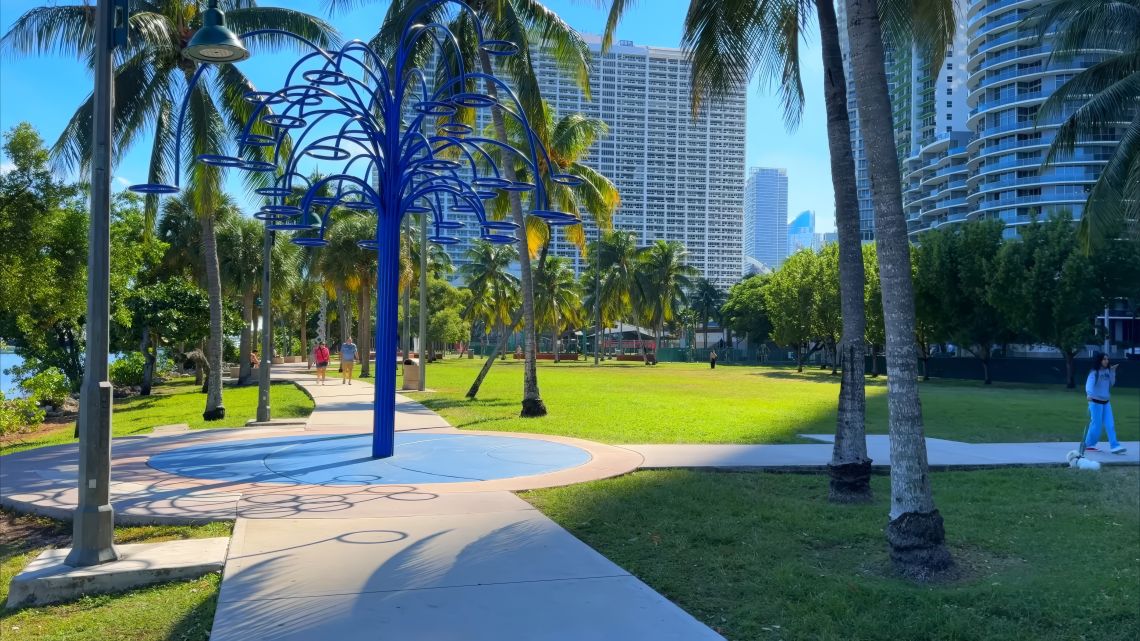
Residents can walk to Margaret Pace Park, local cafes, fitness studios, and several grocery options without needing a car for basic errands.
Midtown and the Design District are also accessible on foot from many parts of the neighborhood.
However, walkability in Edgewater is urban, not quaint.
You’re walking along Biscayne Boulevard corridors and through high-rise clusters, not tree-lined historic streets.
For residents who enjoy city movement and bay views during their daily routine, Edgewater delivers.
For those seeking quiet suburban strolling, it may feel more built-up than expected.
What grocery stores, parks, and daily conveniences are nearby?
Daily convenience is one of Edgewater’s strongest practical advantages.
Grocery stores, pharmacies, banks, pet services, gyms, and coffee shops sit within or directly adjacent to the neighborhood.
Residents frequently use retailers in Midtown Miami for expanded shopping options.
The neighborhood’s recreational anchor is Margaret Pace Park, a bayfront green space offering walking paths, tennis courts, basketball courts, outdoor fitness areas, and dog parks, which you can explore at Dog-Friendly Parks in Edgewater.
Having immediate waterfront park access sets Edgewater apart from many other high-density districts.
Every day of life in Edgewater is built around proximity.
What are commute times and traffic patterns like in Edgewater?
Edgewater benefits from close access to Biscayne Boulevard and the Julia Tuttle Causeway (I-195), which connects directly to Miami Beach.
Downtown Miami is just minutes south, and Brickell is typically a short drive, depending on traffic.
That said, congestion on Biscayne Boulevard is real during peak hours.
Residents who commute daily should expect typical urban traffic patterns.
Remote workers and hybrid professionals often find Edgewater particularly convenient because of its central position between multiple employment hubs.
Location is an advantage — but urban traffic is part of the equation.
Is public transportation available in Edgewater, and can you live there without a car?
Edgewater is served by Miami-Dade County bus routes along Biscayne Boulevard, and residents are within short driving or rideshare distance of the Adrienne Arsht Center Metromover station and Downtown Metrorail connections.
However, Edgewater itself is not directly on a Metrorail line.
Many residents own cars because of Miami’s overall car-centric infrastructure.
That said, remote workers and those who primarily stay in Edgewater, Midtown, and Downtown use rideshare services, biking, and occasional public transit.
Edgewater is more flexible than suburban neighborhoods, but it is not entirely car-free.
Is Edgewater noisy because of construction and traffic?
As one of Miami’s most active development corridors, cranes and new tower deliveries are common sights.
Noise levels depend heavily on proximity to active construction sites and major thoroughfares like Biscayne Boulevard.
Upper-floor units typically experience less street-level noise, while buildings directly along major roads may have more consistent traffic sound.
Buyers sensitive to urban noise should visit properties during peak daytime hours before committing.
Edgewater is dynamic — and that energy includes development activity.
Are short-term rentals allowed in Edgewater condos?
Rental policies vary by building.
Some properties allow short-term rentals with minimum night requirements, while others restrict rentals to 6 months or a year.
Luxury towers often limit short-term leasing to preserve residential privacy and maintain building culture.
Buyers specifically looking for Airbnb-style income must review condominium documents before purchase.
Marketing materials are not sufficient; association rules determine rental feasibility.
Not all Edgewater towers operate the same way.
Is Edgewater more investor-driven or primary-resident focused?
Edgewater attracts both investors and primary residents.
Newer luxury towers may include a significant portion of investor-owned units, especially in preconstruction phases.
However, many buildings also house full-time residents who value the waterfront lifestyle and walkability.
Investor concentration depends heavily on the building itself rather than the overall neighborhood.
Some towers feel transient. Others operate more like long-term residential communities.
Building culture matters as much as location.
Is Edgewater primarily renter-occupied or owner-occupied?
Edgewater contains a mix of both owner-occupied and renter-occupied units.
Luxury towers often include investor-owned condos that are leased long-term, while certain boutique buildings maintain a higher percentage of full-time residents.
Since the neighborhood is condo-dominated, renter presence is more noticeable than in single-family-home areas.
However, building culture varies significantly depending on rental policies and association governance.
Prospective buyers who prefer stability should review owner-occupancy ratios when evaluating specific buildings.
Is Edgewater overbuilt, and is new supply affecting pricing?
Edgewater has experienced sustained development over the past decade, with multiple high-rise towers delivering inventory in overlapping cycles.
This has occasionally sparked questions about oversupply.
While new supply can temporarily increase competition among sellers, waterfront positioning and proximity to Downtown have supported continued demand.
Market shifts tend to be building-specific rather than neighborhood-wide.
Development momentum defines Edgewater.
Buyers need to evaluate timing with caution.
Who is Edgewater best suited for — and who might not enjoy living here?
Edgewater suits professionals, remote workers, investors, and buyers prioritizing water views and central access.
It appeals to those who appreciate modern amenities, concierge living, and elevated urban density.
It may not suit buyers seeking large private yards, historic charm, or fully detached single-family neighborhoods.
Construction activity and vertical growth remain part of the environment.
In short, Edgewater is for those comfortable living above ground level, both literally and strategically.
What public and private schools serve the Edgewater Miami area?
Edgewater is zoned within Miami-Dade County Public Schools, and school assignments depend on the exact building address.
Families typically research nearby options such as traditional public elementary and K–8 centers within the City of Miami, as well as charter and magnet programs in surrounding districts.
Since Edgewater is primarily a high-rise condo neighborhood rather than a suburban single-family zone, many families also explore private schools in nearby areas such as Midtown, the Upper East Side, and Downtown.
School enrollment boundaries can shift, so prospective buyers should verify zoning directly through the Miami-Dade County Public Schools address lookup tool before purchasing.
For households prioritizing top-rated public school zones or larger residential campus districts, exploring nearby neighborhoods with established school reputations may also be part of the decision process.
Visit Best Schools in Edgewater to explore the public and private schools around the area.
VISITING EDGEWATER
Is Edgewater a good place to stay when visiting Miami?
Edgewater offers a quieter alternative to high-energy Miami Beach while remaining close to major attractions.
Visitors who prefer condominium-style accommodations with kitchen access, bay views, and fewer crowds often choose Edgewater as their base.
It is less nightlife-driven than South Beach and less art-centric than Wynwood, but its location allows convenient access to both.
For a balanced stay, Edgewater is an ideal option.
Is Edgewater better than Downtown or Wynwood for visitors?
That depends on what kind of trip you want. Downtown places you in the center of corporate Miami with high-rise density and immediate access to business districts.
Wynwood is art-driven and nightlife-heavy. Edgewater sits between them, offering quieter waterfront surroundings while remaining close enough to access both within minutes.
Visitors who prefer scenic mornings over street art crowds often favor Edgewater as their home base.
What is there to do in Edgewater?
Edgewater centers around waterfront living. Margaret Pace Park provides open green space for jogging, yoga, and dog walking with Biscayne Bay as the backdrop.
Many visitors use the area for sunrise walks and waterfront relaxation.
Dining options cluster along Biscayne Boulevard and extend into Midtown and the Design District.
While Edgewater itself is not a nightclub district, its adjacency to entertainment hubs makes it flexible for itineraries.
It operates more as a residential vantage point than an activity-heavy destination.
For a typical day in Edgewater, check out Top 5 Things to Do in Edgewater.
How close is Edgewater to Miami Beach and major attractions?
Miami Beach is accessible via the Julia Tuttle Causeway and typically reachable within minutes, depending on traffic.
Downtown Miami, Brickell, Wynwood, and the Design District are all nearby.
Edgewater’s centrality is one of its defining strengths.
You are positioned between multiple districts rather than confined to one.
Are there hotels in Edgewater, or is it mostly residential?
Edgewater is predominantly residential.
Traditional full-service hotels are fewer than those in Downtown or Miami Beach.
Many visitors stay in condo-style rentals within residential towers.
Travelers seeking large hotel amenities may explore nearby districts while using Edgewater as a quieter base.
For hotel recommendations in the area, visit Top 5 Hotels in Edgewater.
Is Edgewater walkable for tourists?
Yes, particularly for waterfront walks and access to nearby Midtown.
However, for beach access or nightlife-heavy areas, transportation is typically required.
Visitors who enjoy morning views, park access, and proximity rather than immersion in party districts tend to prefer Edgewater.
Where can visitors eat near Edgewater?
Dining near Edgewater includes casual cafes, waterfront restaurants, and access to the culinary scenes of Midtown and the Design District.
The variety ranges from everyday dining to upscale experiences within a short driving distance.
While Edgewater itself is not a standalone dining destination, its adjacency significantly expands options.
The Top 5 Places to Eat in Edgewater shows some of the best restaurants around the area.
Is parking difficult for visitors?
Parking varies by building and street.
Residential towers usually provide guest parking on a limited basis, while street parking can be constrained during peak periods.
Visitors should confirm that accommodations provide assigned parking or access to nearby garages.
Urban density requires planning.
When is the best time to visit Edgewater?
Winter and early spring generally offer the most comfortable weather in Miami, with lower humidity and fewer storms.
Summer brings higher temperatures and afternoon rain patterns.
Since Edgewater is not driven by seasonal tourism like Miami Beach, crowds are less intense year-round.
-topaz-upscale-2.1x.jpeg?w=1140)
UNDERSTANDING EDGEWATER
Why has Edgewater developed so quickly?
Edgewater’s rapid development stems from its waterfront positioning and proximity to Downtown Miami.
As Brickell filled vertically, developers moved north, capitalizing on bayfront land parcels and zoning allowances for height.
What was once a mix of low-rise housing transformed into a high-rise corridor in less than two decades.
The skyline reflects that acceleration.
Why is real estate in Edgewater considered expensive?
Waterfront access, modern construction, and amenity-rich buildings elevate pricing.
Direct bay exposure commands premium values throughout South Florida, and Edgewater offers that without crossing onto Miami Beach.
Central positioning further supports price stability.
Buyers pay for location, view, and convenience.
Is Edgewater considered a luxury neighborhood?
Yes, particularly along the bayfront.
The presence of branded towers and concierge-service buildings positions Edgewater within Miami’s upper-tier condo market.
However, the neighborhood still includes older mid-rise inventory, making it mixed-tier rather than exclusively ultra-luxury.
What demographics live in Edgewater?
Edgewater attracts professionals, entrepreneurs, international buyers, remote workers, and investors.
The population skews toward condo-dwelling adults rather than large suburban families.
Income levels trend above Miami’s median due to the pricing structure.
How does Edgewater compare to Midtown, Downtown, and the Upper East Side?
Compared to Midtown, Edgewater offers more waterfront exposure and more residential towers.
Compared to Downtown, it is less office-driven and slightly quieter at night.
Compared to the Upper East Side, it is more vertical and less historic.
Each neighboring district offers a different density and lifestyle rhythm.
What is the long-term investment outlook for Edgewater?
Edgewater’s waterfront geography provides long-term structural value.
Demand for bay views and central access remains strong, though development cycles can influence short-term pricing movement.
Investors should evaluate supply timing, building quality, and resale competition.
Geography remains its strongest advantage.
How resilient is Edgewater to climate and infrastructure challenges?
Being directly along Biscayne Bay requires ongoing attention to elevation standards, storm preparedness, and city infrastructure improvements.
Newer buildings are constructed under updated codes, but climate resilience remains a broader discussion.
Buyers should research building engineering, seawall protections, and city adaptation planning.
What will Edgewater likely look like in the next decade?
Edgewater will likely continue its vertical expansion with additional luxury towers and redevelopment of remaining mid-rise parcels.
Infrastructure improvements and community pressure may shape traffic and green space planning over time.
The cranes may eventually slow, but the neighborhood’s identity as Miami’s residential waterfront high-rise corridor is already established.
-topaz-upscale-2.1x.jpeg?w=1140)
.png)
Edgewater, Miami, Florida - EVERYTHING You Want to Know
Find a different side to Edgewater, one that will make you fall in love with Miami living ...
.png)
The Ultimate Guide to Miami-Dade's Top 25 Gated Communities for Single-Family Homes
Discover Miami's top gated communities in this essential guide for luxury home buyers...


Miami's BEST Restaurants in EVERY Neighborhood
Check out the absolute BEST restaurants in every neighborhood of Miami, including the best...
Selling Your Home?
Who are we?
We are the ALL IN Miami Group out of Miami.
We are Colombian, Filipino, Cuban, German, Japanese, French, Indian, Syrian, and American.
We are Christian, Hindu, and Jewish.
We are many, but we are one.
We sell luxury homes in Miami, Florida.
Although some of our clients are celebrities, athletes, and people you read about online, we also help young adults find their first place to rent when they are ready to live on their own.
First-time buyers?
All the time!
No matter what your situation or price range is, we feel truly blessed and honored to play such a big part in your life.