



Naranja, Miami — A Cheat Sheet for Buyers, Visitors, & the Curious

Amit Bhuta
I use non-traditional marketing to inspire the most motivated buyers to pay the max for Miami luxury homes...
I use non-traditional marketing to inspire the most motivated buyers to pay the max for Miami luxury homes...
Until recently, agriculture defined the land around Naranja.
Back then, fields, nurseries, and fruit groves shaped daily life across this stretch of South Miami-Dade, and the community itself remained still and quiet compared to the rapidly expanding neighborhoods farther north.
Today, that landscape is gradually changing.
New housing is reshaping parts of the area, transportation improvements along the South Dade corridor are making commuting easier, and those searching for more affordable homes are increasingly exploring communities near Homestead and Princeton.
Naranja is now at the heart of this exciting shift, where remnants of South Miami-Dade’s agricultural past meet the realities of modern residential growth.
You might be wondering what it's like living in Naranja today.
Or maybe you're curious about the types of homes being built in Naranja and how the area compares with nearby neighborhoods.
What role does Naranja play in the broader evolution of South Miami-Dade?
This guide explores those questions, offering a clearer picture of Naranja’s past, present, and the factors shaping its future.
Here's what you need to know about living in, visiting, and understanding Naranja, Miami.
-topaz-upscale-2.1x.jpeg?w=1140)
LIVING IN NARANJA
Where exactly is Naranja located within Miami-Dade County?
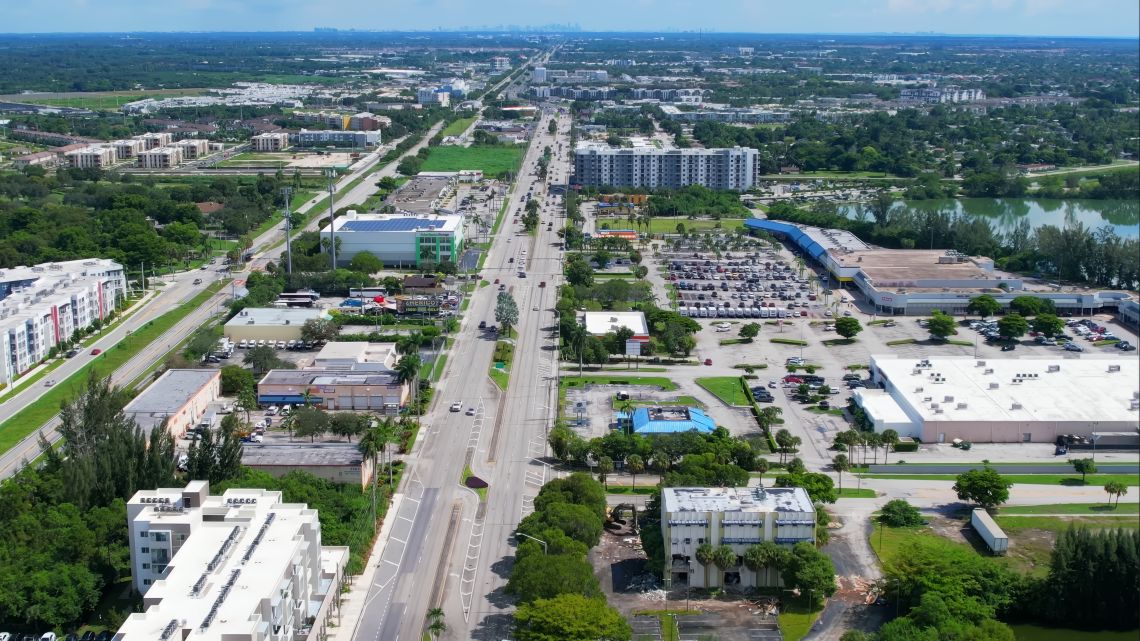
Naranja is a small South Miami-Dade community along the historic US-1, also known as the South Dixie Highway corridor, just north of central Homestead and just south of Princeton.
It sits in the southern part of the county near major South Dade destinations, with Florida’s Turnpike to the east and agricultural land and Redland-related areas farther west.
In practical terms, Naranja is one of those communities people pass on the way to Homestead, Florida City, Everglades National Park, and the Upper Keys, but has its own identity rather than functioning as a mere pass-through.
Is Naranja a city or an unincorporated community governed by Miami-Dade County?
Naranja is not its own municipality.
It is an unincorporated community and census-designated place in Miami-Dade County, which means county government handles many of the services and planning rules that a city would otherwise manage for itself.
That matters for buyers because zoning, policing, redevelopment policy, and many service questions usually route through Miami-Dade County rather than through a separate Naranja city hall.
What is the overall character of the Naranja area today?
Naranja feels like a transition zone.
It blends older apartment and townhouse clusters, modest single-family sections, newer housing projects, and a commercial spine along South Dixie Highway, all while sitting close to agricultural South Dade rather than fully built-out suburban Miami.
That gives the area a grounded, working, everyday feel rather than a polished master-planned image, which is part of why some buyers see value in Naranja; others prefer more established suburban communities farther north.
What neighborhoods or residential communities make up the Naranja area?
The names that come up most often in and around Naranja include Naranja Lakes, Naranja Gardens, and newer residential enclaves in the South Dixie Highway corridor and the nearby Homestead side of 33032.
Some addresses marketed as Homestead or Miami overlap with what locals still think of as greater Naranja, which is why you will often see listings use Naranja, Homestead, or Miami somewhat interchangeably.
For buyers, the smartest move is to look beyond the mailing label and focus on the exact street, school assignment, flood zone, and surrounding block pattern, because those factors shape daily life far more than the listing headline.
What types of homes are available in Naranja?
Naranja offers buyers a wider spread of entry points than many more expensive parts of Miami-Dade.
You will find condos and lower-priced attached units in places like Naranja Lakes, older townhome and apartment-style options, compact single-family homes, and newer builder products that skew toward modern townhomes and small single-family layouts.
That range is one reason the area is popular with first-time buyers.
Someone shopping in Naranja may decide between a lower-cost older unit and a newer four-bedroom townhome rather than being forced into a single housing type.
How much do homes typically cost in Naranja compared with nearby Homestead and Princeton?
Naranja tends to sit in a more attainable lane than many central Miami neighborhoods, but it is not a bargain-basement market.
Broadly speaking, older condo units in communities such as Naranja Lakes often fall in the $150,000–$250,000 range, while older townhomes or smaller single-family homes are typically around $300,000–$420,000, depending on condition and location.
Newly constructed homes, including modern townhomes and single-family homes in nearby developments, often land roughly in the $420,000–$550,000 range or higher, especially when floor plans reach 1,400–2,000 square feet with three to four bedrooms.
A useful way to think about it is this: Naranja can offer lower entry points than many suburban areas farther north in Miami-Dade, but newer construction is already pricing like a serious South Dade home search rather than a hidden bargain.
Are there new residential developments or housing projects underway in Naranja?
Yes, and that is one of the clearest signs that Naranja is changing.
Newer residential products in and around Naranja include builder communities such as Luminara, where floor plans in the search results cluster around roughly 1,300 to 1,500 square feet and commonly offer three to four bedrooms.
Meanwhile, affordable and workforce-oriented projects in the broader Naranja corridor are also part of the redevelopment push.
That mix tells you a lot about the area’s direction: it is not growing in just one lane, but through both market-rate and income-targeted housing tied to county redevelopment goals.
Why are many first-time homebuyers choosing Naranja in recent years?
The short answer is math and geography.
Naranja gives buyers a better shot at finding a home in South Miami-Dade without jumping straight to the price levels seen in many neighborhoods farther north, while keeping them near major roads, transit infrastructure, schools, shopping, and the broader Homestead-Princeton job-and-services orbit.
It also appeals to buyers who do not need a glossy lifestyle district and would rather trade prestige for more square footage, a newer floor plan, or a lower monthly payment.
What grocery stores, shopping areas, and everyday services are closest to Naranja residents?
For everyday needs, one of the most obvious anchors inside Naranja is the Walmart Neighborhood Market at 14325 SW 268th Street.
Residents also rely on retail and service clusters along South Dixie Highway and neighborhood shopping centers such as Naranja Plaza.
Meanwhile, more complex errands can be done farther south around Homestead and Florida City, as the mix expands and includes larger box stores, medical offices, and extensive dining options.
That means Naranja is not a place where you have to drive half a day to buy detergent, but it also is not a polished one-stop lifestyle district where everything is wrapped into one master-planned town center.
What parks and outdoor recreation areas are located near Naranja?
Naranja Park is the closest named county park to the community, at 14150 SW 264 Street.
Just west of the main corridor, Camp Owaissa Bauer at 17001 SW 264th Street offers a different outdoor option with a much larger natural setting used for camps, retreats, and group recreation, while the South Dade Trail provides residents and cyclists a long corridor connection through South Miami-Dade.
If you want a bigger water-and-bay outing, Homestead Bayfront Park is farther south and is one of the more appealing day-trip style park options for Naranja residents.
Meanwhile, for parks that allow dogs, visit Dog-Friendly Parks Near Naranja.
What public schools serve students living in Naranja?
The public school names most closely associated with Naranja are Dr. William A. Chapman Elementary School at 27190 SW 140th Avenue and Coconut Palm K-8 Academy at 24400 SW 124th Avenue.
Because zoning can shift by exact address, some households in the broader Naranja area can feed into different schools than someone just a few blocks away, especially once you move past the elementary and K-8 level.
For that reason, the best buyer habit is to treat school names as likely nearby options, then verify the exact attendance assignment using the property address before assuming a school is guaranteed.
Are there charter or private schools located near the Naranja area?
Yes, and families looking beyond the standard "attendance zone" route do have options nearby.
On the charter side, Somerset Academy Silver Palms K-8 at 23255 SW 115th Avenue and Somerset Academy Silver Palms at Princeton at 13390 SW 248 Street are both notable, and Mater Academy Bay is another tuition-free K-12 charter option to consider in South Dade.
For private schools, the Homestead-Leisure City orbit offers families options such as Lincoln-Marti School and other religious or independent campuses.
However, commute time and grade availability matter a lot more than simply seeing the word “nearby” on a map.
For more information, check out Best Schools in Naranja.
What hospitals and healthcare facilities are closest to Naranja residents?
The biggest full-service hospital serving the area is Homestead Hospital, part of Baptist Health, at 975 Baptist Way in Homestead.
It offers a broad selection of core services, including emergency care, maternity, imaging, orthopedics, and other hospital-level needs, which is why it is the name that comes up first for most Naranja residents when they talk about nearby healthcare.
For everyday care rather than a hospital visit, residents also use urgent care, primary care, dental offices, and specialty practices spread throughout Homestead, Princeton, and the larger South Dade corridor.
How safe is Naranja compared with other South Miami-Dade communities?
Naranja is one of those places where broad labels can mislead people.
Some parts feel straightforward and residential, while other pockets show more visible wear, heavier traffic, or redevelopment pressures, so safety is best assessed at the block level rather than in a sweeping sentence.
Because Naranja is unincorporated, county law enforcement patrols the area, so one should pay close attention to lighting, property upkeep, surrounding uses, and how a street feels day and night rather than relying on a single online reputation score.
What transportation options are available for residents commuting from Naranja?
For drivers, the basic framework is simple.
US-1 is the main spine through the community, Florida’s Turnpike provides a faster regional route to other parts of the county and beyond, and local east-west roads such as SW 264th Street and Campbell Drive shape day-to-day access.
For non-drivers, bus service and the South Dade Transitway corridor are the major mobility pieces, which is a real advantage compared with some outer-edge communities that depend almost entirely on private cars.
Does the South Dade Transitway provide transit access for Naranja residents?
Yes. Naranja is in the orbit of the South Dade Transitway system, and county planning documents specifically identify the SW 264 Street station area as part of the Naranja station framework and a focus for more walkable, transit-oriented growth.
That does not mean every home in Naranja suddenly functions like a downtown apartment next to heavy rail, but it does mean the area has stronger transit bones than many people expect when they first hear the name.
How long does it take to commute from Naranja to major employment centers like Kendall, Doral, or Downtown Miami?
Homestead and Florida City are quick local runs, taking typically about 5–15 minutes depending on traffic and exact location.
Kendall is the more realistic “daily commuter north” target for many households, with drive times usually around 30–45 minutes during lighter traffic, but closer to 45–60 minutes or more during peak hours, especially along US-1 or major east–west connectors like SW 264th Street.
Downtown Miami and Doral are much longer trips. In lighter traffic, you might see 45–60 minutes to Downtown and 50–70 minutes to Doral, but during rush hour, those drives can stretch to 1 hour 15 minutes to 1 hour 45 minutes or longer, depending on congestion and route.
In plain English, Naranja works best for people whose jobs are in South Dade, whose schedules are flexible, or who are willing to trade longer commute times for more attainable housing options.
What are the trade-offs of living in Naranja, and who might not find it a good fit?
Naranja is not the right fit for everyone, and understanding the trade-offs is important before deciding to move here.
Buyers looking for a polished, master-planned suburban environment with walkable retail, consistently newer infrastructure, and a more curated neighborhood feel may find areas farther north in Miami-Dade better aligned with their lifestyle.
Commute distance is another key factor.
While Naranja works well for those based in South Dade, daily travel to Downtown Miami or Doral can be long and unpredictable during peak hours.
The area also shows noticeable variation from block to block.
Some sections feel more established, while others are still in transition, which may not appeal to buyers who prefer a more uniform neighborhood environment.
In simple terms, Naranja tends to work best for buyers who prioritize value, space, and long-term growth potential over immediate polish and proximity to central Miami.
Are flooding or hurricane-related risks something homeowners in Naranja should consider?
Yes, and that should be treated as normal South Florida due diligence rather than as a Naranja-only red flag.
Naranja is low-lying South Miami-Dade, so buyers should check flood zone maps, drainage conditions on the exact street, roof age, shutters or impact protection, elevation, and insurance costs before closing.
In a neighborhood where some properties are older, and some are much newer, resilience can vary from one block or building to the next.
-topaz-upscale-2.1x.jpeg?w=1140)
VISITING NARANJA
What is there to see or do when visiting the Naranja area?
Naranja itself is more practical than touristy.
Visitors typically treat it as a useful South Dade base rather than a destination with a trove of attractions within its own boundaries, using it to access Homestead, Florida City, Redland, Biscayne National Park, and the Everglades region.
That said, the area works well for travelers who want a low-key launching point and do not mind that the sightseeing is mostly a short drive away rather than concentrated on one main street.
For a typical day around Naranja, visit Top 5 Things to Do in Naranja.
How close is Naranja to Homestead’s attractions and the Redland agricultural district?
Very close. That is one of Naranja’s more practical advantages, because you are near Homestead’s commercial core and also within easy reach of Redland’s agricultural attractions, nurseries, farm stands, and specialty food stops.
So if someone wants a home base that can pivot between errands, old-school South Dade scenery, and classic local weekend outings, Naranja sits in a useful spot.
What parks, nature areas, or outdoor recreation spots can visitors explore near Naranja?
For nearby outdoor time, Naranja Park is the straightforward local answer.
For more space and a more natural feel, Camp Owaissa Bauer and the South Dade Trail give visitors a better sense of the wider South Dade landscape, while Homestead Bayfront Park is a stronger option for a bayfront outing.
If the goal is nature with a bigger payoff, most visitors ultimately pair Naranja with a trip to Biscayne National Park or Everglades National Park rather than expecting the neighborhood itself to deliver a full tourism package.
What restaurants or casual dining spots are located around Naranja?
Naranja’s dining scene is more corridor-based than district-based.
You will find everyday chain and fast-casual names directly along South Dixie Highway in and around Naranja, including places like Taco Bell, Pizza Hut, Wingstop, and nearby McDonald’s, and a broader mix opens up as you move into Homestead and Florida City.
That means Naranja works for practical meals, but people looking for a more memorable South Dade food run usually end up widening the search radius.
Top 5 Places to Eat in Naranja names some of the best restaurants in the area.
Is Naranja a convenient base for visiting Everglades National Park or the Florida Keys?
Yes, especially for travelers who want to stay on the mainland and keep options open.
Naranja sits along the southward route system, making it relatively easy to head toward Everglades National Park via Florida City or continue toward the Upper Keys, which is one reason South Dade communities often appeal to people doing nature-heavy itineraries.
It is not the glamorous resort version of South Florida, but it is a practical jumping-off point.
For nearby hotel options, visit Top 5 Hotels Near Naranja.
Are there farms, fruit stands, or agricultural attractions near Naranja that visitors can explore?
Absolutely, and this is one of the area’s strongest identity markers.
Naranja sits close to the agricultural world that gives southern Miami-Dade its distinct flavor, and nearby attractions such as Fruit & Spice Park in Homestead make that connection especially visible.
Even when visitors are not at a specific attraction, the surrounding landscape makes it obvious that this part of the county still carries a different rhythm from the denser urban north.
What major roads and highways connect travelers to Naranja?
The main road everyone should know is US-1, also known as South Dixie Highway.
That corridor runs directly through the community and links north toward the rest of Miami-Dade and south toward Homestead and Florida City, and Florida’s Turnpike provides the bigger regional connection many drivers use for longer trips.
SW 264th Street is another key local connector, directly linking the Naranja station area to surrounding neighborhoods.
UNDERSTANDING NARANJA
Why is the community called Naranja?
The name comes from the Spanish word for orange.
That is not random branding or a modern developer invention, but a direct nod to the orange groves that once shaped the area.
It is one of those South Dade names that quietly preserves the agricultural history even as the landscape changes.
What is the history of the Naranja community in South Miami-Dade?
Naranja is rooted in the agricultural history that defined much of southern Miami-Dade.
Orange groves, nurseries, and productive farmland once framed daily life here, and the community also developed along transportation corridors that assisted in earlier South Dade growth, including the old Florida East Coast Railroad line.
That background helps explain why Naranja still feels different from newer suburban neighborhoods built all at once, because its pattern came from a slower, layered history rather than a single master plan.
What is the Naranja Lakes area, and why is it often mentioned when discussing the neighborhood?
Naranja Lakes is one of the most prominent names in the area because it is a recognizable residential pocket within the broader Naranja story.
It also comes up often because Miami-Dade created the Naranja Lakes Community Redevelopment Agency, which focuses on improving and guiding redevelopment across that area through projects, planning, and investment strategy.
So when people talk about Naranja’s future, Naranja Lakes is often part of the conversation because it is not just a neighborhood label, but also a redevelopment focus area.
What is the Naranja Community Urban Center, and why does it matter for future development?
This is one of the most important hyper-local planning concepts tied to Naranja.
The Naranja Community Urban Center is a county-led planning and zoning framework that guides development in the area, particularly along key corridors where mixed-use projects, walkability, and more intentional, higher-density growth are encouraged rather than scattered suburban expansion.
For anyone trying to understand why certain projects, building densities, retail layouts, or transit-oriented developments keep appearing in Naranja, this framework is one of the main forces shaping those decisions.
How has Naranja changed as South Miami-Dade continues to grow and develop?
Naranja has shifted from being viewed primarily as a quiet, agriculture-adjacent community to one increasingly discussed in terms of housing growth, redevelopment, transit access, and corridor planning.
That shift is visible in the mix of newer residential developments, affordable housing initiatives, station-area planning along the Transitway, and county-led redevelopment efforts tied to Naranja Lakes and the urban center framework.
In other words, Naranja is no longer defined by its past, but is experiencing active growth and development.
-topaz-upscale-2.1x.jpeg?w=1140)
Naranja, Miami, Florida - EVERYTHING You Want to Know
stash the snacks, silence the notifications, and buckle up — we're about to...
.png)
The Ultimate Guide to Miami-Dade's Top 25 Gated Communities for Single-Family Homes
Discover Miami's top gated communities in this essential guide for luxury home buyers...

Miami's BEST Restaurants in EVERY Neighborhood
Check out the absolute BEST restaurants in every neighborhood of Miami, including the best...
Selling Your Home?
Who are we?
We are the ALL IN Miami Group out of Miami.
We are Colombian, Filipino, Cuban, German, Japanese, French, Indian, Syrian, and American.
We are Christian, Hindu, and Jewish.
We are many, but we are one.
We sell luxury homes in Miami, Florida.
Although some of our clients are celebrities, athletes, and people you read about online, we also help young adults find their first place to rent when they are ready to live on their own.
First-time buyers?
All the time!
No matter what your situation or price range is, we feel truly blessed and honored to play such a big part in your life.