



What Nobody Tells You About Living in The Moorings

Amit Bhuta
I use non-traditional marketing to inspire the most motivated buyers to pay the max for Miami luxury homes...
I use non-traditional marketing to inspire the most motivated buyers to pay the max for Miami luxury homes...
Ask anyone with a boat slip in The Moorings how they like living there, and expect a sigh, a smile, and the word "blessed."
It's a fair reaction — this pocket of Coconut Grove delivers waterfront views, Old Florida charm, and privacy that your mail carrier might be the most exciting visitor you get all week.
The marinas are close, the schools are strong, and Coral Gables' Cuban sandwiches are a golf-cart ride away.
The Moorings is like a retirement fantasy you haven't earned — yet.
That said, every enclave has its quirks, and the ones tucked behind a 24-hour gate tend to be the best-kept secrets of all.
But if you talk to the right neighbor at the right cocktail hour, the story gets a lot more interesting.
Here are five things nobody tells you about living in The Moorings.
 (50).png?w=1140)
1) How Many Homes Are Actually Here? Depends Who's Counting
The first neighborhood mystery shows its face before the moving truck because nobody can agree on the headcount.
Published profiles say The Moorings has anywhere from 39 to 43 homes, while another current guide uses a wider estimate because lot combinations and redevelopment can change what qualifies as one residence.
The number may depend on whether someone is counting original lots, current parcels, completed houses, or two properties that have been merged into one estate large enough to require its own weather system.
What does not change is that this remains a tiny, gated collection of single-family homes rather than a large subdivision with several hundred roofs competing for attention.
That scale keeps through-traffic low and makes the enclave far quieter than its central Miami location would suggest.
It also means a major renovation, demolition, or parade of cement trucks can become the neighborhood’s shared podcast for the next eighteen months.
Homes do not enter the market in a steady stream, so anyone waiting for the perfect layout may spend a long time refreshing listings that continue to feature the same three kitchens.
The gate provides strong separation from the public, but fewer than fifty homes won't offer much room for complete anonymity once the contractors, visitors, and delivery drivers begin arriving.
A single property change can alter the count again, especially when neighboring lots are combined, or an older house is replaced by a much larger estate.
That shifting total explains why confident neighborhood descriptions can disagree all while claiming to have counted correctly.
The honest answer is that The Moorings contains roughly forty homes, followed by an asterisk wearing very expensive loafers.
 (51).png?w=1140)
2) Waterfront Name, Landlocked Reality (For Some)
The neighborhood name sounds as though every backyard includes a dock, a yacht, and someone named Captain Roberto.
It does not.
The Moorings sits along Biscayne Bay and includes private docks and direct bay access, but the homes occupy a mix of waterfront and interior positions.
Some properties have direct bay or canal frontage, while others receive the prestigious waterfront community address without any private water touching the lot.
One community profile identifies only five waterfront homes among 43 residences, which is a useful warning against letting the neighborhood name define the entire inspection.
A distant water glimpse, access to shared boat facilities, and a private dock capable of holding a serious vessel are three very different real estate features.
The exact property needs answers about frontage, dock rights, water depth, vessel capacity, bridge clearance, shoreline permits, and whether the seawall has begun sending subtle retirement notices.
Direct waterfront owners also inherit salt exposure, tidal movement, dock maintenance, seawall repairs, storm preparation, and insurance questions that interior homeowners may experience differently.
Flood designation and elevation vary by individual lot, so two homes behind the same gate can present different insurance and construction concerns.
Interior properties can still enjoy the privacy, tropical setting, community docks, and bayfront identity without paying for every piece of infrastructure required to retain a backyard attached to Biscayne Bay.
The Moorings gives every home a nautical mailing address.
However, only the survey, title documents, and shoreline inspection can confirm whether the boat belongs in the backyard or on the vision board.
 (52).png?w=1140)
3) Your HOA Check Doesn't Cover Your Roof, Sorry
The HOA payment is the cover charge, not a home warranty.
Current listings display monthly-equivalent fees ranging from about $833 to $1,185, including one waterfront estate showing a $3,000 quarterly assessment.
That variation alone is reason to confirm the current amount through association records and an estoppel rather than trusting whichever listing website loaded first.
Available community information describes the fee as supporting gated entry, private roads, and general neighborhood upkeep instead of an extensive package of shared resort services.
The owner remains responsible for the private home, including the roof, landscaping, structural systems, and exterior maintenance.
A waterfront property adds its own dock, seawall, and shoreline infrastructure to that personal responsibility list, because the HOA is not wandering over with a wrench every time the tide looks suspicious.
The guardhouse can screen visitors, but it cannot negotiate with an aging barrel-tile roof or explain why three air-conditioning systems chose the same week to rebel.
Exterior changes and major redevelopment may also involve association review alongside city zoning, tree protections, coastal rules, setbacks, and permitting requirements.
Before closing, the useful questions concern fee history, security coverage, private-road obligations, architectural approvals, pending projects, insurance, and precisely where community maintenance ends.
At these property values, the HOA assessment may be one of the smaller ownership expenses, which does not make surprise responsibilities any more charming.
The check helps protect the setting and the gate, while the mansion beyond them remains your magnificent, high-maintenance dependent.
 (53).png?w=1140)
4) Coconut Grove Is Close, Just Not Casual-Stroll Close
The Grove is near enough for a dinner reservation and far enough that nobody should promise a breezy walk home after dessert in August.
The Moorings sits in South Coconut Grove, east of Main Highway and removed from the busier commercial center around CocoWalk, Commodore Plaza, and Grand Avenue.
A current neighborhood guide places the village shops and restaurants roughly five to ten minutes away under ordinary driving conditions.
Most trips to the Grove’s commercial core happen by car or golf cart because the layout and distance do not create effortless front-door walkability.
That separation is part of The Moorings' privacy package rather than a planning accident.
The enclave avoids having restaurant traffic, nightlife, and curious pedestrians circulating outside every driveway, but it also prevents croissants and cocktails from becoming purely pedestrian errands.
Walking within the leafy residential area can be pleasant, while walking home with groceries requires more commitment, less humidity, and perhaps a support vehicle.
Main Highway and nearby regional routes provide useful access, although peak traffic can stretch trips toward Coral Gables, Brickell, and Downtown Miami beyond their optimistic estimates.
The location works because the Grove’s dining, parks, marinas, and shops remain convenient without becoming the neighborhood’s background noise.
It does not offer the central-Grove routine where coffee, dinner, shopping, and people-watching all begin outside the lobby.
The Moorings has proximity with a privacy buffer, which is excellent for seclusion and less for anyone determined to collect every daily step organically.
 (54).png?w=1140)
5) 1935 Charm Meets 2026 Price Tag Whiplash
The housing stock has skipped the idea of a normal age range and assembled several architectural generations behind one gate.
Current listings include a 1935 Mediterranean home asking $7.785 million, a 1951 house asking $11.9 million, a 2008 waterfront estate asking $29.5 million, and a 2026 new build asking $9.75 million.
That is not a tidy market sample so much as four different eras arguing over the same gate code.
An older estate may offer historic proportions, mature landscaping, craftsmanship, and renovations completed across several decades by owners with very different opinions about marble.
It may also require close review of the roof, plumbing, electrical systems, windows, drainage, permits, additions, and any charming feature that becomes significantly less charming when an insurer notices it.
A new house can bring current construction methods, modern layouts, and elevated living areas, but its age does not automatically make its lot, location, privacy, or water access superior.
Construction year explains only one piece of the value because lot size, elevation, waterfront position, dockage, square footage, architecture, and redevelopment potential can outweigh the birthday printed in the property record.
Price per square foot becomes especially clumsy when one home is a restored Mediterranean residence, and another is a newly built concrete statement with eight bathrooms and no interest in subtlety.
A 1935 house may have received nearly every major upgrade, while a much newer property may still need expensive design changes before it works for a particular household.
Sparse sales make comparisons harder because the most recent closing may differ dramatically in frontage, lot size, condition, and whether a boat can park behind it.
Buying in The Moorings therefore requires valuing the land, the structure, the water relationship, and the renovation history separately before allowing the asking price to be a complete explanation.
WHO GETS THE MOST OUT OF LIVING IN THE MOORINGS?
Those who want Coconut Grove privacy without moving far from its best parts
The Moorings doesn't intend to win everyone over, which is part of why it works.
Its appeal comes from being small, gated, heavily residential, and just removed enough from central Coconut Grove to avoid turning every driveway into overflow parking for brunch.
The entrance creates a real break from Main Highway, while the low number of homes keeps the enclave from taking on the scale or bustle of a larger luxury community.
That setup gives The Moorings a subtler daily rhythm without pushing the neighborhood into remote-estate territory.
CocoWalk, restaurants, marinas, parks, Coral Gables, Brickell, and Downtown Miami remain close enough to use regularly, even when they are not close enough to reach in flip-flops carrying an iced coffee.
The Moorings also makes sense when privacy matters more than shared amenities, because the main attraction is the setting itself rather than a clubhouse trying to justify its square footage.
Interior properties can enjoy the gate, mature landscaping, and bayfront identity without taking on every seawall, dock, and saltwater expense attached to direct waterfront ownership.
Waterfront homes add another level of appeal, but The Moorings does not require a private dock to deliver the enclosed, low-traffic atmosphere that defines the neighborhood.
Its mix of historic estates, renovated houses, and ambitious new construction also gives the streets more visual character than a community where every roof arrived in the same shipping container.
The neighborhood works best when a large private home, a guarded entrance, and access to the Grove matter more than uniformity, simplicity, or a long amenity menu.
At its strongest, The Moorings offers seclusion without exile and prestige without placing a velvet rope around everyday life.
WHO MAY WANT TO KEEP LOOKING?
Anyone who wants waterfront certainty, easy upkeep, and a walk-to-everything Grove address
In The Moorings, a private home may come with an aging roof, several air-conditioning systems, mature trees, a pool, elaborate landscaping, and exterior surface area to keep contractors emotionally invested.
The HOA protects the entrance and shared setting, but it does not arrive with a tool belt every time the house develops a new opinion about rain.
Waterfront properties add docks, seawalls, tides, salt exposure, storm preparation, flood review, and insurance questions to a budget that was already doing quite well on its own.
The neighborhood name can also create false confidence because not every home has direct water frontage, dock rights, or the same boating access.
Interior lots may solve part of that problem, but they also may not satisfy anyone expecting a yacht behind the kitchen simply because “Moorings” appears on the address.
The location requires another adjustment, since central Coconut Grove is nearby but not woven into the neighborhood as a walk-out-the-door routine.
A dinner reservation is convenient, while walking home afterward may become an endurance event sponsored by humidity.
The small number of homes also limits choices, which means the right floor plan, lot, construction year, and waterfront position may not appear by demand.
Older estates can demand detailed inspection work, while newer mansions can carry prices that appear to have skipped several normal steps in the conversation.
The Moorings is a weaker match when the goal is simple maintenance, guaranteed boating, effortless walkability, and a property market with enough options to comparison-shop without forming a long-term relationship with the listings page.
AN HONEST TAKEAWAY
What living in The Moorings really comes down to
The Moorings is a privacy bargain written in seven figures.
It trades the central Grove’s walk-out-the-door energy for a gated pocket where traffic is lighter, streets are quieter, and strangers generally need a reason to be there.
That trade explains why the village is close rather than woven into daily life.
The water adds another layer of prestige, although The Moorings distributes that benefit unevenly between direct-frontage homes and interior properties.
A bayfront estate may guarantee the full postcard, while another address receives the same neighborhood name without a dock at the bottom of the lawn.
The housing stock refuses to behave neatly as well, with historic homes, major renovations, redevelopment lots, and new construction all sharing a market too small for easy comparisons.
That variety gives The Moorings charm, but it also turns valuation into a detailed argument about land, age, elevation, frontage, construction quality, and how many bathrooms a house truly needed.
The HOA keeps the enclave private and exclusive, while the real maintenance burden remains firmly attached to each estate.
Nothing about The Moorings is especially simple, including the home count, water access, the ownership costs, or the pricing.
Its appeal comes from choosing privacy, space, and Coconut Grove access while accepting that every beautiful detail arrives with a survey, an inspection, or an invoice.
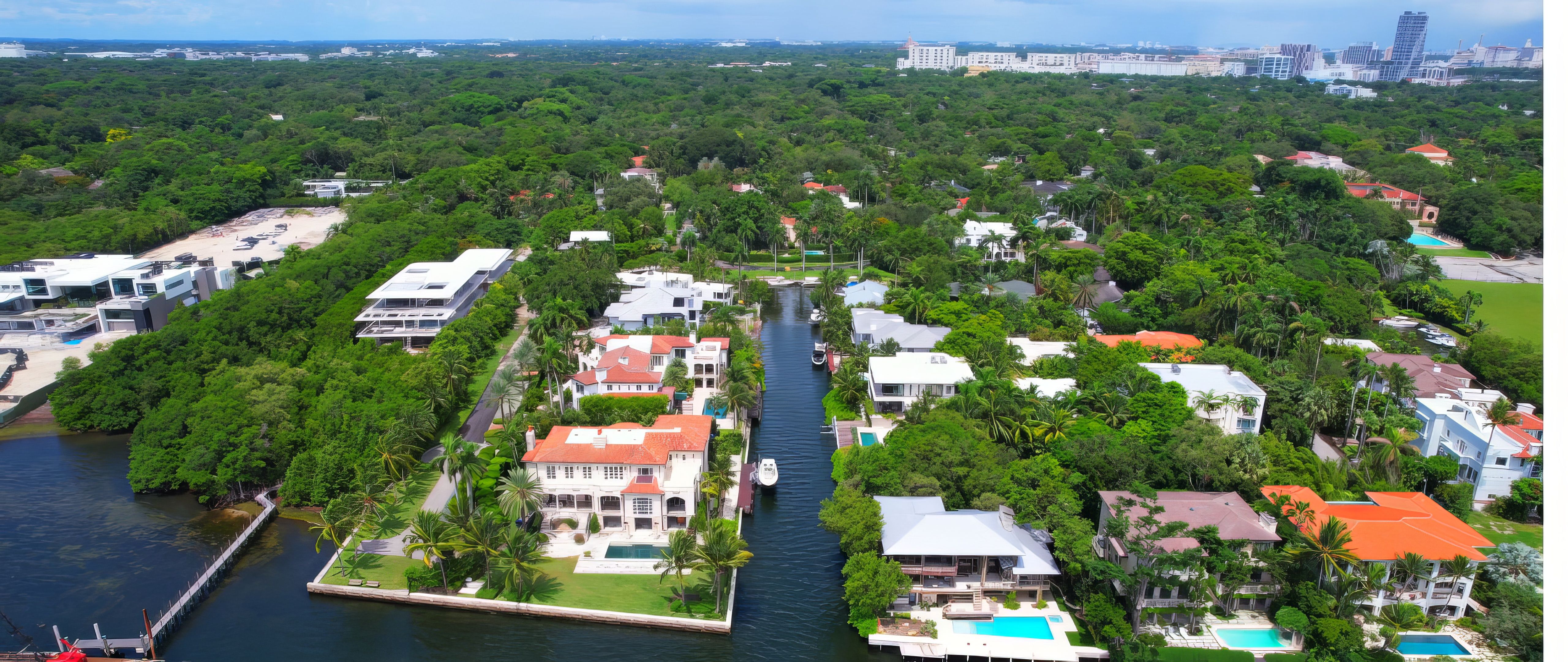%20(25)-topaz-enhance-4x.jpeg)
The Moorings, Miami, Florida - EVERYTHING You Want to Know
Whether you're longing for laid-back days or seeking hidden spots that amaze, let our...
.png)
The Ultimate Guide to Miami-Dade's Top 25 Gated Communities for Single-Family Homes
Discover Miami's top gated communities in this essential guide for luxury home buyers...


Miami's BEST Restaurants in EVERY Neighborhood
Check out the absolute BEST restaurants in every neighborhood of Miami, including the best...
Selling Your Home?
Who are we?
We are the ALL IN Miami Group out of Miami.
We are Colombian, Filipino, Cuban, German, Japanese, French, Indian, Syrian, and American.
We are Christian, Hindu, and Jewish.
We are many, but we are one.
We sell luxury homes in Miami, Florida.
Although some of our clients are celebrities, athletes, and people you read about online, we also help young adults find their first place to rent when they are ready to live on their own.
First-time buyers?
All the time!
No matter what your situation or price range is, we feel truly blessed and honored to play such a big part in your life.