



What Daily Life Looks Like on Sunset Islands

Amit Bhuta
I use non-traditional marketing to inspire the most motivated buyers to pay the max for Miami luxury homes...
I use non-traditional marketing to inspire the most motivated buyers to pay the max for Miami luxury homes...
Nobody moves to Sunset Islands for shopping on their street because they already know there aren't any shops.
These four gated islands in Miami Beach are all about residential living, with historic bridges, beautiful homes, and a small neighborhood park where residents spend their free time in nature.
Some houses have kept their Mediterranean-style details for decades, while others have traded the old-school look for modern designs with plenty of glass.
And behind those front doors, residents keep busy with their own projects, from restoring original woodwork to researching the islands' surprising connection to early Hollywood.
"Hopping" from one island to the next? Even visiting a friend may mean a longer drive, as the northern and southern islands have separate guarded entrances.
Fortunately, the rest of Miami Beach is close enough for an afternoon at a museum, a friendly bowling match, or a movie night.
So, contrary to popular belief, living on these islands is more than admiring beautiful houses, but having one to come home to certainly doesn't hurt.
Here’s what a typical day is like on Sunset Islands.
The Two-Gate Diplomat
 (26).png?w=1140)
Early Morning — The Shortcut That Doesn't Exist
A quick visit to a friend shouldn't require much planning, but this Sunset Island III resident knows better than to trust the distance on a map.
Her friend lives on Sunset Island II, just across a narrow stretch of water, yet getting there means leaving through the guarded entrance at 20th Street and driving along North Bay Road to the northern entrance at 29th Street.
She's already arranged her visit, so getting through the second gate is straightforward, even if the trip takes longer than the distance between their houses would suggest.
It's one of the quirks of living on Sunset Islands — four residential islands share a name but not one continuous road.
 (27).png?w=1140)
Late Morning — The Street That Started a Debate
After wrapping up a client call at home, she shifts her focus to another matter involving the neighborhood's roads.
Miami Beach considered traffic-calming measures for Sunset Drive in 2026, following concerns about drivers speeding through Sunset Islands III and IV.
Since she uses that road regularly, she's interested in whether the proposed changes could make the streets safer for people walking, cycling, or simply getting out of their driveways.
She reviews the city's proposal and makes a few notes to share with the neighborhood's property owners' association, knowing that even guarded streets have their share of impatient drivers.
 (28).png?w=1140)
Afternoon — The Park Behind the Other Gate
With her work handled, she heads back to Sunset Island II to meet her friend for a game of chess at Sunset Isle II Park.
Located at 2600 Sunset Drive, the small neighborhood park offers a welcome patch of greenery among the islands' private homes and carefully maintained properties.
They settle down with a portable chessboard, catching up on neighborhood news between moves and occasionally accusing each other of taking suspiciously long to make a decision.
It's a simple way to enjoy an afternoon without leaving the residential setting, although visiting the park from the southern islands still requires that familiar trip through the northern gate.
 (29).png?w=1140)
Evening — The Bowling Alley Nobody Expected
Tonight's plans take her beyond the guarded islands and into a bowling alley, which is probably not the first place most people associate with this part of Miami Beach.
She meets a couple of friends at Scott Rakow Youth Center on Sheridan Avenue, where the six-lane bowling facility welcomes adults and younger visitors.
The center offers weekday evening bowling during its regular season, so they've checked lane availability before heading over.
Between the occasional strike and a few balls that wander toward the gutter, the competition gets entertaining without needing to be particularly good at it.
For someone whose neighborhood doesn't have its own shopping or entertainment district, having places like this nearby makes planning an evening out much easier.
The Original-Details Defender
 (30).png?w=1140)
Early Morning — The Bridge That Outlived the Boom
Most people crossing a bridge think about where they're going, but this Sunset Island II homeowner is more interested in what's holding the bridge up.
As an architectural writer, he's fascinated by the historic bridges connecting the Sunset Islands, particularly their Mediterranean Revival details and distinctive concrete arches.
Three of the original bridges have historic designation, preserving pieces of Miami Beach's development during the 1920s land boom.
On his way out through the northern entrance, he stops at a safe pedestrian spot to photograph the decorative railings and architectural details for a project he's working on.
The bridges have been around longer than most of the houses they serve, giving him plenty to write about before he's even left the neighborhood.
 (31).png?w=1140)
Late Morning — The Door That Refuses Retirement
Back at his Sunset Island II home, he's meeting a restoration specialist to discuss a wooden door that has seen better days.
The house has older Mediterranean-inspired details, and he'd rather repair its original features than replace everything with something that looks straight out of a modern showroom.
Together, they examine the door's hardware, discuss possible repairs, and figure out how to keep its character without sacrificing everyday function.
Of course, preserving older craftsmanship can require more patience than buying a replacement, especially when the smallest decorative details turn out to be the hardest to match.
Still, he enjoys having a home with a little history, and keeping those details intact matters more to him than following every new design trend.
 (37).png?w=1140)
Afternoon — The Neighbor Who Chose the Future
Later, he visits a neighbor who has taken a completely different approach to residential design.
Unlike his older home, the contemporary property features wide glass openings, open living spaces, and shaded outdoor areas designed for South Florida's climate.
The two discuss how modern architects handle natural light, heat, privacy, and the challenges of building near the water.
On Sunset Islands, it's a well-known contrast where traditional Mediterranean-style houses sit along the same residential streets as newly built modern estates.
He leaves with a few photographs and fresh ideas for his writing, although he's still not convinced that every room needs a wall made almost entirely of glass.
 (38).png?w=1140)
Evening — The City That Keeps Changing Its Clothes
His interest in architecture takes him to South Beach tonight, where The Wolfsonian–FIU is hosting a discussion as part of Miami Beach's November 19, 2026, Culture Crawl.
The evening features architectural historian Jean-François Lejeune discussing The Other Rome: Building the Modern Metropolis 1870–1960, a book exploring how Rome developed beyond its ancient center.
For someone who spends his days comparing the old and new houses of Sunset Islands, it's an opportunity to hear another perspective on how cities change over time.
He listens to the discussion, takes a few notes, and considers how the same questions about preservation and redevelopment apply to the neighborhood he calls home.
It's a fitting end to a day spent examining architecture, from the old bridge near his house to the much bigger story of how cities decide what deserves to be preserved.
The Film-Reel Detective
 (33).png?w=1140)
Early Morning — The Camera Crew Has to Be on the List
Filming a documentary requires plenty of preparation, but this Sunset Island IV resident has one extra item on her checklist: making sure the camera crew can get through the gate.
She's an independent documentary producer who spends part of the year in Miami Beach, and today she's recording an interview at her home.
Before her collaborators arrive, she confirms their visit arrangements through the southern guarded entrance and makes sure the interview space is ready.
There are lights to position, microphones to test, and furniture to move out of the camera frame, all before anyone asks the first question.
Fortunately, she's working with a small crew, although even two people can bring a surprising amount of equipment through the front door.
 (34).png?w=1140)
Late Morning — The Hollywood Name on a 1925 Map
After the interview, she returns to another history project involving the very islands she lives on.
Her research has led her to Stephen A. Lynch, a businessman with major ties to the early motion-picture industry who helped develop Sunset Islands beginning in 1925.
The islands were planned during Florida's land boom, but residential construction didn't begin in earnest until the mid-1930s, after the real estate market had gone through some difficult years.
She spends the morning examining historical records and photographs, tracing how an ambitious development project eventually became one of Miami Beach's most exclusive residential communities.
The connection to early Hollywood is especially important to her, as the islands later became associated with entertainers such as Desi Arnaz, Carmen Miranda, and Jimmy Durante.
It's certainly more research material than she expected from a neighborhood whose most obvious attractions are beautiful homes and guarded entrances.
 (35).png?w=1140)
Afternoon — The Editing Room With a Library Card
With her research notes organized, she heads to Miami Beach Regional Library on 22nd Street to work on her documentary footage.
The library's YOUmake creative space offers resources for video production, photography, music production, and other hands-on projects, making it a useful option for local creators.
Armed with her library card, she uses an available editing workstation to review interview footage, organize audio clips, and make adjustments to her project.
It's a practical alternative to setting up additional production equipment at home, particularly when she needs a dedicated workspace for a few hours.
Unlike equipment rentals, which can quickly add up during a documentary project, having access to public creative resources is a welcome advantage.
 (36).png?w=1140)
Evening — The Birdcage Comes Back to Miami Beach
Her day ends with a film screening that connects nicely with her interest in the city's entertainment history.
She's attending O Cinema South Beach's special 30th-anniversary screening of The Birdcage on November 19, 2026, part of the nonprofit cinema's Give Miami Day fundraising activities.
The 1996 comedy is closely associated with Miami Beach, making the screening an entertaining way to revisit a familiar film in the city where much of its story unfolds.
As she settles into the theater, she's as interested in the movie's depiction of South Beach as she is in the jokes that have kept audiences laughing for three decades.
For a documentary producer living on islands developed by a businessman with early Hollywood connections, spending the evening at an independent cinema is a particularly appropriate way to finish the day.
THE BIGGER PICTURE OF LIFE ON SUNSET ISLANDS
What do these three different routines tell us about Sunset Islands?
Sunset Islands may occupy a relatively small part of Miami Beach, but living on these islands is more than enjoying a beautiful address on Biscayne Bay.
The four islands were designed as private residential enclaves, and that arrangement still shapes how people move around, welcome visitors, and plan their days.
Having guarded entrances and streets without through-traffic provides a level of privacy uncommon in a busy coastal city.
However, the same arrangement means residents rely on nearby parts of Miami Beach for groceries, entertainment, public services, and just about everything that doesn't happen at home.
Even the separation between the northern and southern islands can make a simple visit less convenient than what it seems on a map.
Still, those extra trips may be a reasonable trade-off for people who value having a quieter residential setting without moving far from the city's cultural and commercial attractions.
There's also something interesting about a neighborhood where nearly century-old architectural features coexist with homes designed for a very different generation of homeowners.
Some residents appreciate the craftsmanship and character of older properties, while others prefer contemporary designs that make better use of modern materials and coastal building techniques.
Those changing preferences can keep the neighborhood visually interesting, yet preserving its history while allowing new construction isn't always a straightforward conversation.
And despite the impressive properties and controlled entrances, the islands aren't completely separate from the practical concerns facing the rest of Miami Beach.
Road safety, infrastructure improvements, rising property expenses, and the challenges of maintaining homes near the water are still in the picture.
The neighborhood's entertainment history adds another dimension, connecting its early development to the movie business and reminding us that these residential streets have seen quite a few changes since the 1920s.
Sunset Islands is distinct because much history, personal choices, and everyday responsibilities exist within four small islands that seem remarkably simple from a distance.
The guarded bridges may control who comes through, but the lives unfolding beyond them are what give Sunset Islands its character.
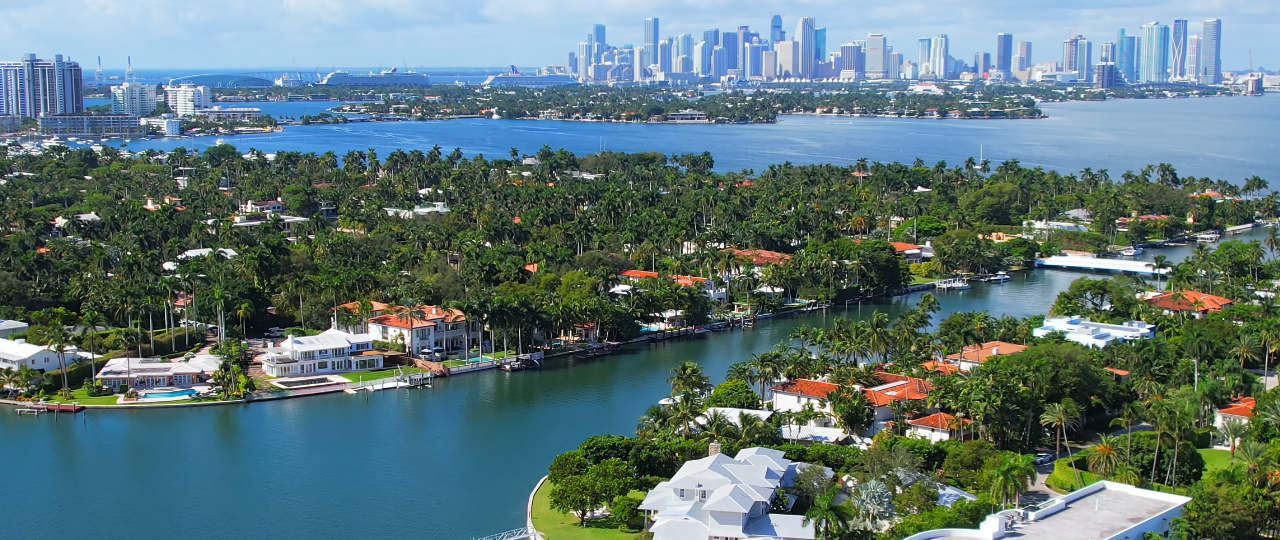
Sunset Islands, Miami, Florida - EVERYTHING You Want to Know
Enjoy your free ticket to a virtual journey across all the layers of Sunset Island! By the...
The Ultimate Guide to Miami-Dade's Top 25 Gated Communities for Single-Family Homes
Discover Miami's top gated communities in this essential guide for luxury home buyers...


Miami's BEST Restaurants in EVERY Neighborhood
Check out the absolute BEST restaurants in every neighborhood of Miami, including the best...
Selling Your Home?
Who are we?
We are the ALL IN Miami Group out of Miami.
We are Colombian, Filipino, Cuban, German, Japanese, French, Indian, Syrian, and American.
We are Christian, Hindu, and Jewish.
We are many, but we are one.
We sell luxury homes in Miami, Florida.
Although some of our clients are celebrities, athletes, and people you read about online, we also help young adults find their first place to rent when they are ready to live on their own.
First-time buyers?
All the time!
No matter what your situation or price range is, we feel truly blessed and honored to play such a big part in your life.