



Top 5 Things You May Not Know About Biscayne Point

Amit Bhuta
I use non-traditional marketing to inspire the most motivated buyers to pay the max for Miami luxury homes...
I use non-traditional marketing to inspire the most motivated buyers to pay the max for Miami luxury homes...
Dig through the little-known stories amid the tranquil canals of Biscayne Point, a secure, often guard-gated presence along Biscayne Bay.
Set your sights on this peninsular neighborhood at the northern end of Miami Beach, shaped during the final wave of South Florida's land-boom era and bordered by water on nearly every side, a.k.a., Biscayne Point — a petite residential pocket offering a private, water-oriented lifestyle wrapped in luxury.
Designed with inward-facing streets, engineered canals, and an unusually deep shoreline reach, Biscayne Point consists of three islands that lie to the west of Miami Beach mainland and a selection of single-family residences, many on oversized lots and in architectural styles ranging from original 1950s–1960s ranch and mid-century homes to extensively renovated modern waterfront estates.
While many people are quick to view Biscayne Point as just another canal-lined residential community—or confuse it with neighboring waterfront districts—it carries a distinct legacy of its own.
And we're about to discover just what it is.
Here are five things you may not know about Biscayne Point.

The Waterfront Deal That Time Forgot
In 1925, Biscayne Point was advertised in a Miami Daily News headline as "the last available waterfront at reasonably low prices."
Mind you, this line wasn't invented by modern marketers but appeared verbatim in federally archived historic documentation.
At the time, developers were already framing Biscayne Point as a closing chapter of Miami's land-boom era, and what makes this fact charming is how familiar the pitch still sounds a century later.
Even then, Biscayne Point was positioned as a rare opportunity, and buyers were being sold urgency, exclusivity, and water access in one neat package.
And today, that headline feels more like an accidental prophecy, making Biscayne Point one of the few Miami neighborhoods where the original sales story aged better than expected.
.png?w=851)

A Neighborhood Designed to Touch the Water
Biscayne Point's waterfront-heavy layout? It's engineered.
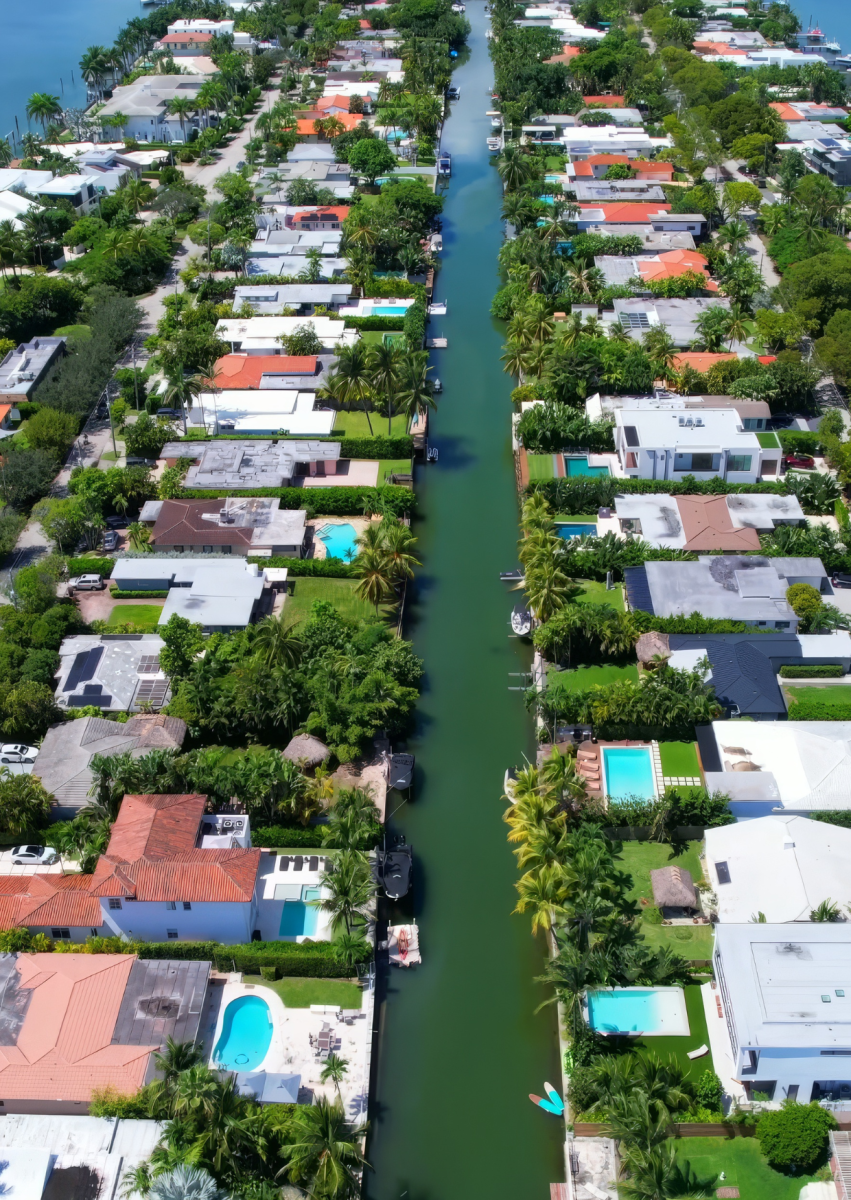
Platted in 1926, the neighborhood was intentionally designed as a peninsula extending deep into Biscayne Bay, where a central canal cut directly through the land to maximize shoreline exposure.
Historic planning records describe the project as an "uncommon success" in offering waterfront access to almost every lot, which explains why Biscayne Point is unusually water-forward compared to standard Miami grids.
Here, streets curve, lots stretch long, and rear yards consistently meet the water, allowing it to dictate how Biscayne Point functions.
Even residents who aren’t boat owners live with daily proximity to canals and bay views, reinforcing a shared coastal atmosphere that still defines the area today.

Privacy With a Paper Trail
Unlike many guarded neighborhoods, Biscayne Point's security is not just a private arrangement — it's formalized through public governance.
In 1990, the city and county approved a Security Guard Special Taxing District specifically for the neighborhood, making Biscayne Point's 24-hour guarded access a legislated, publicly documented service.
Over the years, the district's operations have appeared in city resolutions, budget reports, and public hearings.
In fact, even funding details are transparent, down to per-home assessments and annual operating costs.
And in 2018, residents approved a formal transfer of oversight from the county to the city through an official vote, proving once again that Biscayne Point's sense of order has remained consistent over time.
-topaz-upscale-2.3x-2.jpeg?w=851)

When Biscayne Bay Was Still Being Drawn
Biscayne Point sits on land that didn't always exist in its current form.
In fact, state and federal records describe the late 1920s through the 1950s as an era of intense dredge-and-fill activity in this part of Biscayne Bay, while a 1928 U.S. Coast & Geodetic Survey map already shows Biscayne Point as filled land with streets laid out when surrounding areas were still taking shape.
That makes Biscayne Point an early fixture in Miami Beach, with later environmental documents tracking how the shoreline and canals stabilized into their modern configuration.
It also explains why its docks, seawalls, and lot edges feel so precise that even today's layout can be traced back to those early maps.
.png?w=851)

A Dock Count That Says Everything
In the early 1980s, a federal Biscayne Bay management study counted 93 docks along Biscayne Point's shoreline — a figure that placed the neighborhood among the most dock-dense stretches in that section of the bay.
And boy, does this snapshot speak volumes about how boating-oriented Biscayne Point already was decades ago.
Indeed, boating isn't just a recreation in Biscayne Point, and docks aren't decorations — they both fill its celebrated identity.
.png?w=851)
.png)
The Ultimate Guide to Miami-Dade's Top 25 Gated Communities for Single-Family Homes
Discover Miami's top gated communities in this essential guide for luxury home buyers. Exp...


Miami's BEST Restaurants in EVERY Neighborhood
Check out the absolute BEST restaurants in every neighborhood of Miami, including the best...
Selling Your Home?
Who are we?
We are the ALL IN Miami Group out of Miami.
We are Colombian, Filipino, Cuban, German, Japanese, French, Indian, Irish, Syrian, and American.
We are Christian, Hindu, and Jewish.
We are many, but we are one.
We sell luxury homes in Miami, Florida.
Although some of our clients are celebrities, athletes, and people you read about online, we also help young adults find their first place to rent when they are ready to live on their own.
First-time buyers?
All the time!
No matter what your situation or price range is, we feel truly blessed and honored to play such a big part in your life.